
We live in a culture that has a very complicated relationship with the word busy. On one hand, we wear it like a badge of honour where being busy signals that we’re important, productive and needed. On the other hand, the wellness world has spent the last decade telling us that busy is basically a modern disease and that we need to slow down, pause and be present.
I think both of those perspectives are missing something crucial.
In my experience the problem is not really busyness. Most people who are exhausted, overwhelmed and depleted are not struggling because their lives are too full, they’re struggling because their lives are full of the wrong things.
There’s a profound difference between a life that is full and a life that is overloaded, and that difference has less to do with how much you’re doing and more to do with whether what you’re doing is in alignment with what truly matters to you.
The framing of “busy” in modern Western culture is interesting. In many areas of society being busy is seen as admirable. It can almost be elevated to a virtue when it is seen as the opposite of being lazy. Busy is often associated with being productive and working hard. On the flip side of this, we have the modern personal development movement which emphasizes pause and presence, and has almost demonized being busy.
The Two Faces of Busy
I think that the concept of “busy” has two sides, and when I Googled the definition of the word “busy” this was highlighted as the meaning was either being actively engaged, or crowded with activity. On one side we have the definition of busy as having too much to do and habitually overworking, and on the other side we have the concept of busy as being actively engaged in doing something. So, what makes the difference? What determines whether you are busy in a state of overwork and overwhelm, or busy in a state of engagement and aliveness?
The difference, is whether or not what you are doing is in alignment with what is truly important to you.
If you are busy and unhappy, overwhelmed, stressed and exhausted then the problem is probably not that you are busy, the problem is that you are unfulfilled.
It is not a stuff problem; it is an alignment problem.
Doing lots of stuff + unbalanced, unaligned energy > stress, overwhelm, exhaustion
Doing lots of stuff + balanced, aligned energy > a rich and fulfilling life
I don’t think that being busy in and of itself is a problem. Being busy and being stressed do not always go together. I am usually busy, but I phrase it in other ways because most of the time I am living intentionally in alignment with my highest self. The words I use instead are to say that my life is full or rich.
The paramount issue is what is the energy engine underneath your work? What is driving you? Is it performing, trying to prove something, or fear of missing out, losing out or being rejected? Or is it purposeful and creative engagement with life?
What does it actually mean to be in alignment?
The idea of being in alignment with your authentic self, in other words having aligned energy, gets talked about a lot in personal development teachings, especially those with a spiritual aspect to them, but what does that actually mean. Alignment involves knowing and living your values, purpose and higher-self desires. Higher-self desires are those that are connected to your soul rather than your ego. Ego desires are to do with how you appear; the image you portray. They are driven by urgency and doing things for other people, and are about performance, competition and earning. Soul desires come from your inner knowing and feel open and expansive. Other terms for your higher-self desires are your passion or bliss. They are what you would do even if you didn’t get paid. It’s the person you love being and the things you love doing when no one is watching.
Does living in alignment mean you just do what you want?
I want to clarify that living in alignment with yourself does not mean that you only do things that you want to do, although I do invite you to notice any beliefs you have about not being allowed to do what you want. We grow up with a lot of unexamined adopted beliefs about this that can limit how much we allow ourselves to have (if you want to learn more about how to identify and shift your limiting beliefs then there is a chapter on that in my book 10 Steps to Happiness). Life also has responsibilities and curveballs for us to navigate. Alignment is not just about desire and preference; it is also about the perspective that we have when approaching all of life. Having a life philosophy that enables you to release resistance to challenge, and to flow with all aspects of life experience enables you to be in alignment within almost any circumstance.
This doesn’t mean that you just passively accept everything that life throws at you. Being in alignment with yourself also gives you clarity about where and how to create meaningful boundaries for yourself. For me it comes back to the idea that is expressed well in the Christian Serenity Prayer by theologian Reinhold Niebuhr. Here is a simple non-religious form of that:
Stay calm about the things you can’t control.
Have the courage to change the things you can.
and be wise enough to know the difference.
Sometimes alignment comes through what you choose to do, and sometimes it comes by how you frame your perspective of what you are required to do. Wisdom, which is also a form of alignment, guides you to know when to flow in acceptance, and when to actively create what you want.
Invest time to know yourself
When I run after what I think I want, my days are a furnace of distress and anxiety;
If I sit in my own place of patience, what I need flows to me, and without any pain.
From this I understand that what I want also wants me, is looking for me and attracting me.
There is a great secret in this for anyone who can grasp it.
— Rumi
One surefire way to live an unfulfilled life is to be constantly in a rush reacting to life. The key to fulfillment, is to give yourself time and space to become clear on what your values, purpose and highest desires are. Clear energy of thought, emotion and action that is in alignment with your soul is powerful and attractive.
Three questions that reveal your authentic self
Here are three questions that will help you to come to know the key aspects of your authentic self:
-
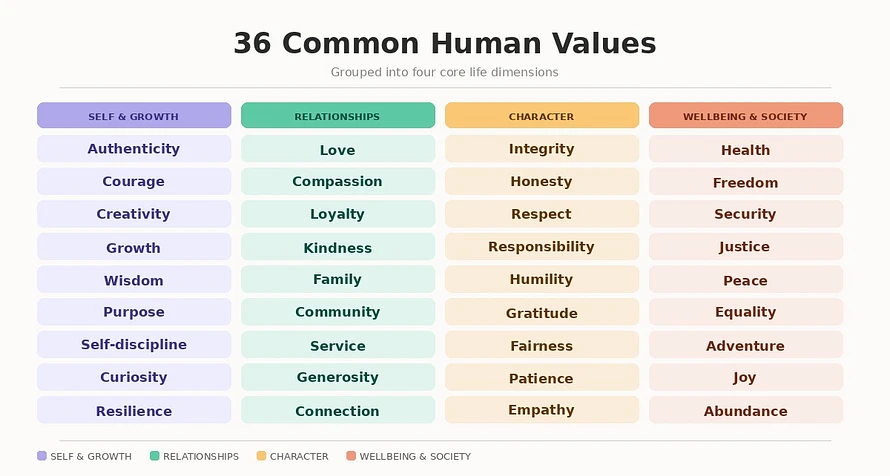
What are your top 10 values?
Think about experiences you have had where you have felt high levels of joy, pride, or frustration. Things that give you a lot of joy or pride are connected directly to your values. Conditions that make you feel angry or frustrated indicate what your important boundaries are, in other words, what values have been denied or disrespected.
Below is a list of 36 common values that may help you to identify your own.
-
What are your top 10 innate gifts and practiced strengths?
Fulfillment happens when you are moving in your strengths. This is not to say that challenge and learning are not purposeful too, but we feel our best when we are living from our strengths. What do you do that feels easy or which you do well without a great deal of effort? What skills or characteristics do other people thank or compliment you for? What do you enjoy doing?
That last question is the most important because doing what you love and what lights you up is your purpose. Your passion is your purpose. What you love is your life force being expressed through you.
-
How do you like to be creative?
Creativity is also the expression of our lifeforce and it is not just about making art. Creativity can be expressed in many ways such as ideas, variation, movement, problem solving, gardening, cooking, exploring and playing.
Coming to know these aspects of yourself will help you to identify what is truly important to you, which is the aligned energy half of the equation of living a fulfilling life. The other half is having balanced energy.
What is balanced energy?
There are two aspects to having balanced energy, and balance is as important as alignment. The two aspects are capacity and creativity. Capacity means how resourced are you to do what you are doing. You can have a lot of capacity and be working from a place of unaligned energy and you will probably still be okay. Conversely, if you are living in alignment with your authentic self but work beyond your physical, mental or emotional capacity then you will experience stress and exhaustion.
The second factor that needs to be balanced is creativity. You can be operating in alignment with your values and strengths and still stagnate and become unfulfilled if you are doing the same things day after day. Stagnation is the opposite of creation and occurs when there is an absence of movement and new energy. When you suppress or do not allow space for your creativity, then you begin to stagnate and stop growing, progressing, and developing. Creativity allows energy to move within you and around you and nourishes your mind and body.
Balanced aligned energy is where you are well resourced physically, mentally and emotionally, and creatively expressing your values, strengths and desires. Different people need different levels of resources at different times, and need to live with different levels of creatively to feel satisfied. Maybe the real question is,
“What allows your life force to flow most abundantly?”
The recipe for a rich and fulfilling life
Busyness itself is not the enemy. When what you are doing reflects your authentic values, strengths, and deeper desires, then a full and active life becomes a source of energy rather than a drain on it. The key is investing time in genuinely knowing yourself: what you value, where your gifts lie, and how your creativity wants to be expressed. Pair that self-knowledge with keeping your energy balanced in terms of personal capacity and creative variety, and busyness transforms from overwhelm into aliveness. The issue isn’t how much you are doing, but how much of what you are doing is meaningful to you.
Just One Thing
This week’s “Just One Thing” action point to help you turn information into transformation through implementation is to reflect on and record responses for the top three questions that reveal your authentic self:
-
What are your top 10 values?
-
What are your top 10 innate gifts and practiced strengths?
-
How do you like to be creative?
If you want to take this to the next level, you can get my ebook Mastering Change which includes a reflection journal. This will guide you to deeper clarity about what is truly driving your current thoughts, feelings and actions, and to identify meaningful change and give you the keys to successfully transform yourself and your life in the ways that you want.
Aroha nui, much love
Janine
The podcast version of this article is available on Substack here and also on Spotify and Apple Podcasts (Janine Lattimore Living Life Well podcast)