At forty-three, I was penniless, alone, sick, and on a welfare benefit. My second marriage had just ended, my body was staging a full rebellion against me, and I was supposed to be a motivational teacher — someone who helped people build happy, meaningful lives. The irony wasn't lost on me. I was drowning in shame, held together by nothing much at all, wondering how on earth I had ended up here. If you're somewhere in your forties and life feels less like the plan you had and more like a pile of rubble you're standing in — I wrote this for you.
When Life Runs You Over and Spits You Out
In my early forties I felt trapped in my life. I had developed severe multiple chemical intolerance and was experiencing sometimes debilitating symptoms where my joints swelled painfully, my energy disappeared, my skin came out in burning, itching rashes and my brain would melt into fog or be hijacked by anxiety. I felt like I had very little time or energy to do the things I wanted to do, or even to have any space for myself. My second marriage was struggling under the weight of stress that we had been and were experiencing. It felt like life had run my husband and I over and spat us out on opposite sides of the road. I thought that I had got it right the second time round, but unexpectedly and painfully, marriage number two came to an end.
Here is what led up to that. I had my son when I was thirty-eight and he was born with digestive conditions that meant he wailed in pain every time I tried to breastfeed him, and he couldn’t sleep lying down. We eventually got him put on a special formula, but not before I looked like I was anorexic from being too scared to eat anything in case it was what was causing the problem. He still didn’t sleep for more than an hour or two at a time until he was about two. Then my father had a stroke and I had to help care for him because my only sibling lived overseas and my mother had died when I was thirty-two. I was also trying to help care for my god-daughter who had abuse issues in her home life, and then she started running away and I would spend days searching for her.
In the midst of all that I began to realise that I was carrying a truck load of fear and guilt, and at my core I hated myself. I also knew that my lack of self-love and acceptance had played a big part in my relationship issues. I felt stuck, exhausted, bound, depressed and like I had been waiting for someone to save me who never came.
The Shame Story We Tell Ourselves
By midlife some people have made it - achieved their goals of career, family and financial success. However, I think that more of us get to midlife and think, “this is not where I had imagined, expected or wanted to be at this point in my life.” For me, I had dreamed of being a happily married, successful motivational speaker, inspiring and helping thousands of people. The reality, at forty-three I had experienced two failed marriages, and I was penniless, alone, sick and on a welfare benefit. I felt broken. I felt fucked up. And I felt like an imposter every time I tried to write or speak about personal growth, health and happiness. It wasn’t just the challenge of the circumstances I was experiencing, it was the shame story I attached to them.
How Did I Get Here? Who’s Been Driving the Bus?
Looking back, I can see that this was a form of midlife crisis. The usual image of a midlife crisis is a man trying to recover his youth by buying a sports car or a motorbike and dating a woman in her twenties. I think it often looks different to this stereotype though. That is just one response to the build-up of stress and obligation we experience by midlife, and to the identity questioning that is a common part of realising that half your life is over and you don't want to keep living your life the same way. For a lot of us that involves ruminating on all the mistakes and bad patterns we have have lived so far, feeling like a failure and feeling broken or crushed by life.
There is Nothing Wrong with You
The end of my second marriage and equal shared custody provided me with both a stimulus and time opportunity to begin doing some deep personal growth work. The first affirmation, or rather healing statement that I made on my journey to loving myself was, “There is nothing wrong with me and I don’t need to be fixed.” I knew the soul truth of it, but it still felt hard to say, and especially to say it out loud to anyone else because I feared how they would judge me. It wasn’t until several years later that I realised I had been using what I perceived as my brokenness as evidence that I deserved to be loved. It was like I had been carrying around two suitcases my whole life. In one was all the painful things that had been done to me which I used as all the reasons I deserved to be loved. This was the one that I would open up and show to people to try and get them to love me. In the other suitcase, was all the things that I had done that I felt guilty or ashamed of. That one carried all the reasons I thought I didn’t deserve to be loved, and I kept it shut. The uncomfortable truth that came to me was that I didn’t feel my own worthiness so I played the small, nice, victim to try and get love. Only it wasn’t love. It was sympathy and attention. That first affirmation started an evolution in me, but it took many years of unravelling and learning for me to know in my whole being that I was not broken, and that I was worthy of love for all of who I am.
The Gold in the Cracks
As I was reflecting on my story in writing this post, I came to understood the Japanese art of Kintsugi in a new way. Kintsugi is an ancient Japanese practice of repairing broken pottery by mending cracks with lacquer mixed with gold, silver or platinum. This highlights the scars as the beauty of imperfection and makes the repaired piece even more unique and valuable. I have always thought it was a beautiful concept, but in writing this it resonated with me deeply and personally. We can feel like we are falling apart in our forties, and that we have been smashed by life, AND we can put the pieces back together with golden love to create something more honest: a self where the cracks and imperfections are visible, but accepted, and in that, somehow a self that is more whole.
For most people, your forties are a pivot point in life and an unravelling. Your forty and falling apart may look like being stuck on an exhausting daily grind treadmill, buried under the weight of the many different hats you wear and the invisible load you carry. It may look like a silent inner scream, or maybe a full physical melt-down of “what about me, it isn’t fair, I’ve had enough now I want my share.”* For all of us, within that unwinding is a cry of “I want to fully live, I want to be free, I want to be me, I want to matter, and I want to be happy. You are not broken, you are reforming. Let the masks you have worn for so long shatter, and from the pieces form your own gold threaded artwork.
Three Things That Helped Me Through
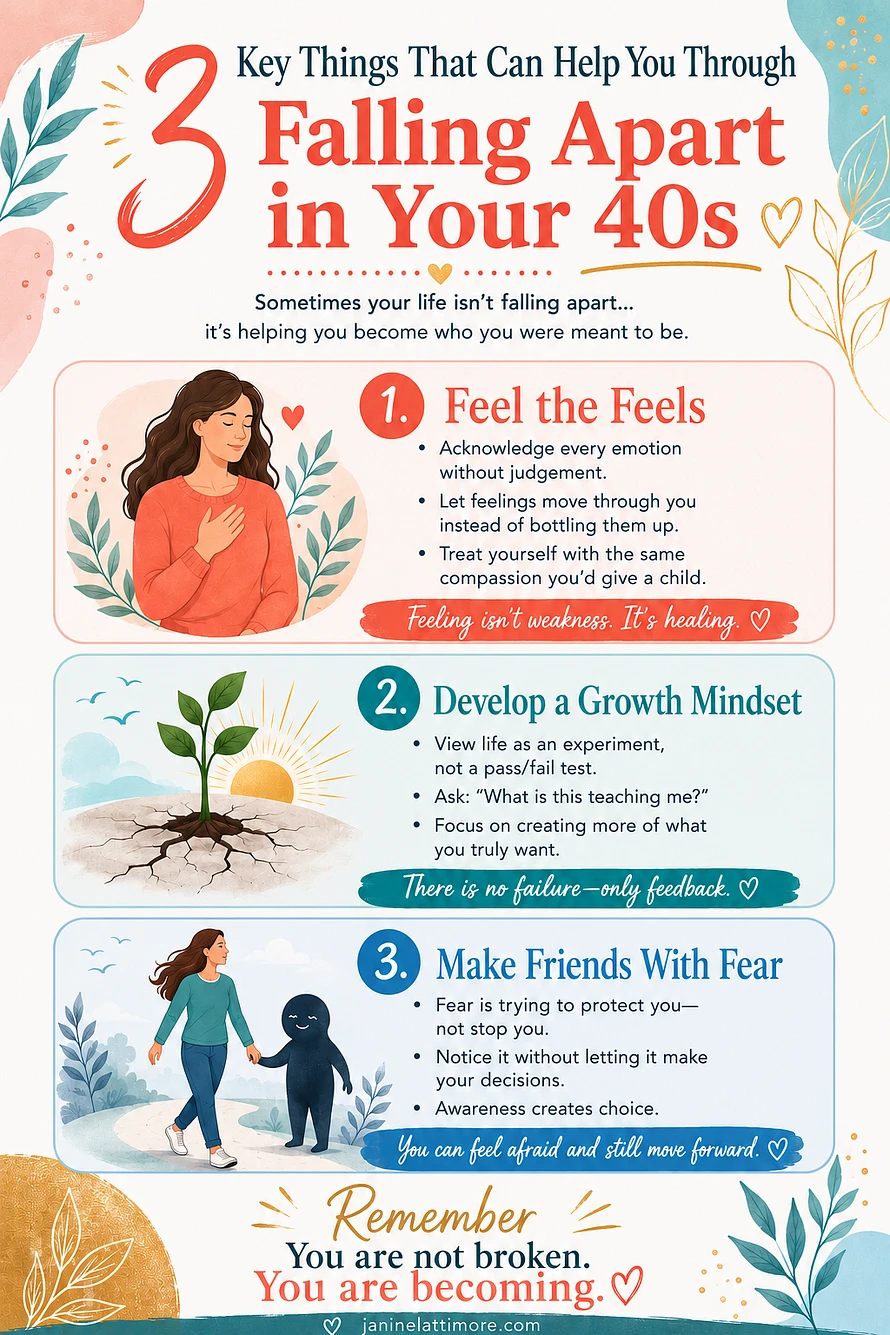
However, it can be very hard to see how you can put the pieces back together when you are in the midst of the breaking and the losing. Let me share three key things that helped me make it through all of my experience of falling apart. These all hinge on the understanding that unravelling can also mean deciphering or figuring out. They are different tools to help you gain information and clarity from your experience that you can then use to move forward in ways that are more authentic to who you really are and creating the life that you want to live.
1. Feel the Feels
Acknowledge your feelings and let them flow through you. Be completely honest with yourself and let it be okay to feel whatever you are feeling. Interact with your feelings as if you were the parent and they were your child. Blocking or suppressing your feelings is like self-abandoning a part of yourself. It also traps the emotional energy within your body which can lead to tension, stress and low energy levels.
2. Develop A Growth Mindset
I did a lot of experimenting and risk taking in my forties. A growth mindset approaches life like an experiment where you try different options and however something works out, it provides information. In this, there is no failure, only learning. From each experience I would ask: what can I learn from this and what is this showing me about what I do want? Then, I would focus on how I could create more of what I wanted.
3. Make Friends with Fear
“Fear is the mind-killer” - Dune.
Fear causes a stress response in your body and makes it difficult to creatively problem solve or to even think logically sometimes. I found it very helpful to understand that fear comes from my subconscious mind trying to keep me safe. Now I think of it like a very diligent, overly cautious security guard warning me when my body feels unsafe. I acknowledge the warning, and then decide how I will respond to it.
“Fearful and limiting thoughts and feelings are not truths, they are purely thoughts and feelings, and are usually based on things you have been taught or experienced in the past. They are connected to old subconscious programming. Celebrate when they come up because it means the unconscious has become conscious, and awareness of them gives you choice. They are not a sign that anything is going wrong. They are simply an element of being human.” - extract from my book The Great Life Planner
From Breaking Point to Turning Point
I won't pretend the falling apart was graceful, or quick, or that there was a single golden moment where everything clicked into place. It was messy and slow, and sometimes I had to find my footing in the dark. But here's what I know now, on the other side of it: the unravelling wasn't the end of my story — it was the beginning of the truest version of it. Your forties aren't asking you to hold it all together. They're asking you to finally put down what was never really yours to carry, and to discover who you are when you stop performing okayness for everyone around you. You are not broken, you are becoming, and that, even when it hurts, is something worth showing up for.
Just One Thing
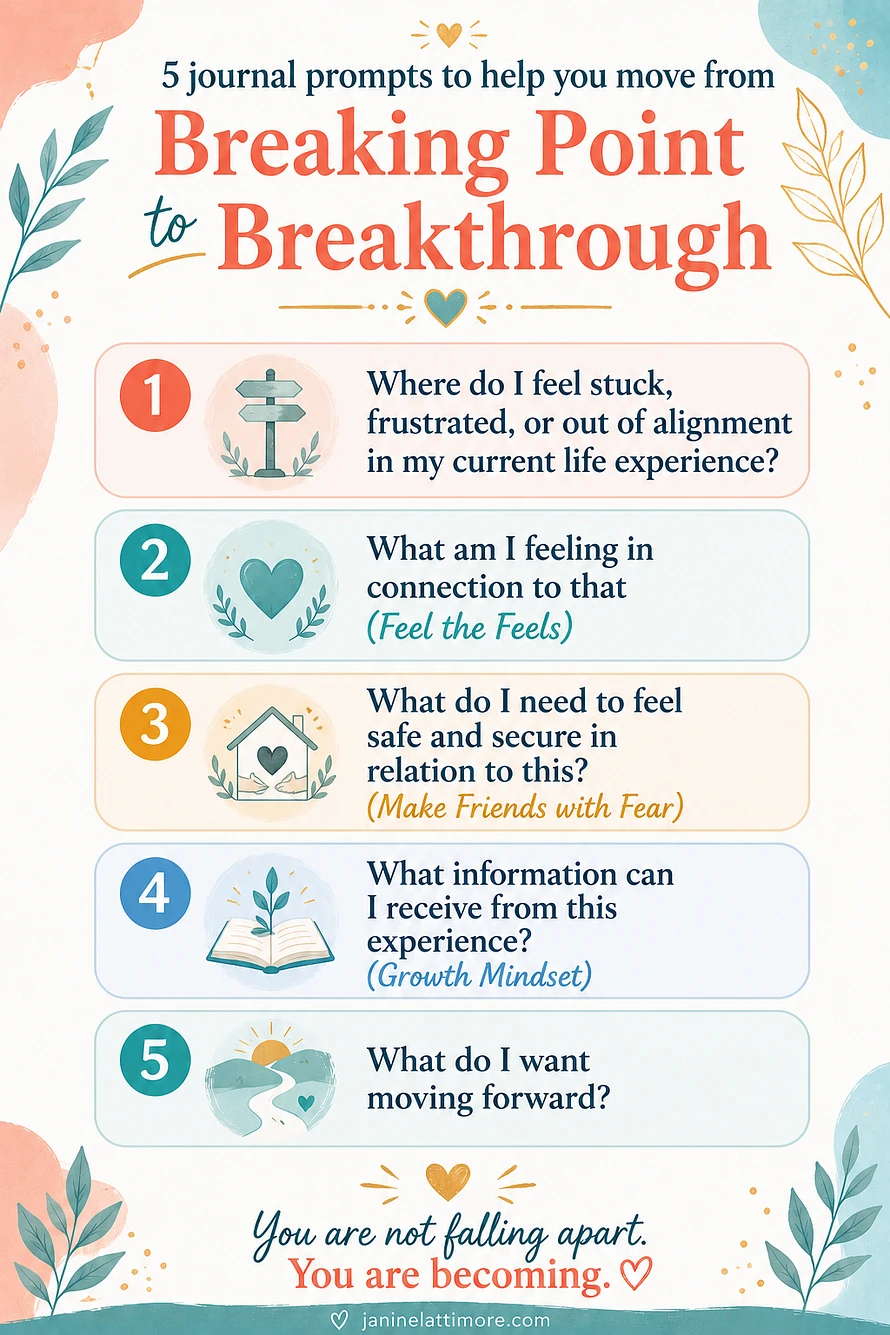
My Just One Thing action point for you this week is a reflection practice. Give yourself some quiet space to consider this series of 5 questions. I recommend handwriting your responses on paper or in a journal or notebook. The process of handwriting enhances the way that you process this with your mind and your body. This practice is something you can repeat any time you are facing a challenge. Here are the 5 questions:
-
Where do I feel stuck, frustrated, or out of alignment in my current life experience?
-
What am I feeling in connection to that (Feel the Feels)
-
What do I need to feel safe and secure in relation to this? (Make Friends with Fear)
-
What information can I receive from this experience? (Growth Mindset)
-
What do I want moving forward?
(I have included an inforgraphic of this below that you can save to your phone or to Pinterest)
Let me know in the comments, what is/was your experience of your forties, and if you did the Just One Thing practice, how was it for you?
Aroha nui, much love
Janine
- Song lyrics from What About Me by Moving Pictures 1982
Want More Simple, Practical Tips to Live Midlife Well?
Subscribe to my Weekly Wellbeing newsletter for quick and easy practices that that fit into real life (small tweaks, big benefits)