
Why is it so Hard to Make Decisions?
Listen to the podcast version of this article here
If you find yourself overthinking every decision, second-guessing yourself or constantly wondering whether you're making the "right" choice, you're in good company and there is nothing wrong with you. Decision-making can be difficult especially in midlife as careers, relationships, family responsibilities and life changes all demand your energy and consideration. If you find it challenging to make the right choice then the real problem may not be that you are bad at making decisions. It may be that you are asking the wrong question. One simple shift in the question you ask yourself can cut through the mental noise, help you stop overthinking and enable you to make decisions that feel calmer, clearer and more aligned with who you truly are.

Why Midlife Makes Decisions Feel Harder
Making decisions can be hard, especially in our forties and fifties. We experience having to make choices and decisions throughout our life, but midlife can be a significant crossroads point for many people. We can be faced with some big questions and choices about our career, our relationships, our children and our finances. In addition to that, many of us in midlife are feeling a shift or loss in our identity. Children leaving home, career changes, menopause, divorce or ageing can all prompt the question, “Who am I now?” and without a clear sense of self, decisions can feel even harder. After years of caring for children, partners or ageing parents and/or giving a large part of yourself to your work, you may have become disconnected from your own desires and don’t even know what you want anymore.
The Real Problem Isn’t Making Decisions...
...It’s Trying to Make the Right Decision
Most people want to make not just good decisions, but the right decision. We can feel even more pressure to do this in midlife when we have children relying on us, bills to pay and the weight of past mistakes sitting on our shoulders. As a result we go into a mental battleground of conditioned beliefs to try and identify the one right and perfect answer:
What should I do?
What would other people do?
What are the pros and cons?
What if I make the wrong choice?
What if I fail?
What if I disappoint someone?
What if people judge me?
What if I miss out on something?
Does any of that sound familiar?
I confess, I like to get things right, do things right, and have things done right. I have perfectionist tendencies and often like to control how things are done so that they are done well. On the flip side of that, I grew up very sensitive to doing the wrong thing or getting things wrong. Having a very critical father probably helped instill that fear in me, but there are personality and neuro-type traits that feed into all this as well.
In many ways these are helpful patterns of behaviour. I can be relied on to do a good job. I am conscientious and I complete things to a high standard.
Then, there is the downside. The almost constant underlying anxiety and regularly pushing myself to the point of burnout. I find it hard to settle if things are messy, undone or out of place. Yes, I am a recovering control freak, and I understand the need to get things right and the fear of making the wrong choice or decision.
Why There Is No One Right Decision
One of the pieces of life wisdom that I learned in my forties was that rightness is subjective and a constantly moving target. When you aim to get everything right the only thing you will be guaranteed to get is stressed. Life is messy, unstructured and not black and white. There is very little, if anything, in life that is absolutely right or wrong. Even laws of the land require bending sometimes to meet particular circumstances.
Yet, when we are trying to make a decision we often ask the question - what is the right thing to do? We may frame it in other ways like what is the responsible thing to do, what is the best thing to do or what should I do, but all these questions are asking the same thing using different language.
Why Trying to Be Right Is So Exhausting
If you are anything like me this leads to a back and forth mental debate that can be exhausting as we try to wrestle out the right choice or decision in our head. There are two reasons trying to make the right decision is so hard and tiring. Firstly, as I have already said, the goalpost of what is right is not set. It moves with different people and perspectives. There is no one objectively right decision - ever - so trying to find it will cause you to toss and turn in your mind and go round and round in thought circles as you argue with yourself.
Your Head and Your Heart Think Differently
The second reason trying to make the right decision is such a challenge is because what your head thinks is right and what your heart thinks is right are often two different things. This is usually why you feel resistance to a thought. It’s because your heart is connecting to something else. Your head and heart are on the same team, but they have different strategies. Your head (head-brain) operates in terms of logic, rationality and patterns. It wants to follow set paths, do what is logically right and fit in with governing systems. I believe your heart is connected to your soul and the wisdom and energy of your body, and it usually operates in terms of a simple, single knowing based on that. It’s like your heart sits in the centre connected to the earth and the heavens speaking one quiet message while your head runs in circles around it like an energetic dog stopping to sniff everything and work out how to please everyone.
Your heart knows that obligation and “shoulds” are not your truth. It holds your truth.
This does not mean that there is no place for logical and rational thinking. It just means that you need to connect to that thinking from a different starting point - from the starting point of what is true for you, rather than what is right.
One Question That Cuts Through the Mental Noise
Here is one way I have found to do that. When I do this I find that it cuts through all the overthinking and noise around making a choice or decision and my path forward becomes clear. It is not always the easiest path, which is why our brain sometimes runs in overthinking circles to avoid it. However, it is the path that is most aligned with our highest self, rather than what other people are directing us to.
It is very simple.
Instead of asking:
“What is the right thing to do?”
Ask:
“What would I do if I truly loved myself?”
Your heart knows the answer to that question, not your head.
Let your inner awareness drop down out of your head, down to your heart and ask the question from there.
What comes up may feel emotional. It may feel uncomfortable. It may not make logical sense, but you will know that it is your truth.
Once you have that, you can then bring your rational head brain back online to help you work out how to implement that.
Why This Question Works
Living from your head and overthinking every decision with trying to do what is right uses up a lot of your energy. It drains you physically, and it drains your lifeforce because you are not connecting with your personal truth. What comes up may appear selfish to your rational brain, but the fact is, you will never feel fully settled or have inner peace unless you follow your heart when it is centred in love.
This is not about just doing what you want as such. Our wants can often be emotion led. That is why I use this particular question rather than just “following my heart”. The question guides you to connect to love and your highest self. From an energy perspective, love has one of the highest frequencies. Making a decision from self-love doesn't mean doing whatever feels good in the moment or ignoring other people. It means choosing from a place of self-respect, honesty and compassion.
Is There Any Science Behind This?
If you think this all sounds a bit “woo woo”, biologically the heart is also a neural centre - a brain. Most people think we only have one brain - the one in our heads, but we actually have three: the head brain (cranial or cephalic) the heart brain (cardiac) and the gut brain (enteric). All three of these neural centres are semi-autonomous and capable of processing, remembering, and making decisions. These three intelligence networks communicate constantly via the vagus nerve and biochemical signals.
Since the 17th-century Scientific Revolution, logic and rational thought have been taught to be the only true source of knowledge. The only knowledge that could be scientifically proven. That understanding is now changing. Researchers such as Dr Bruce Lipton, Dr Joe Dispenza and organisations like the HeartMath Institute have helped bring attention to the remarkable relationship between the heart, the brain and the body. Alongside this, discoveries in neuroscience and other areas of science continue to deepen our understanding of human intelligence and awareness. In many ways, modern research is beginning to validate something that people have intuitively experienced for thousands of years; that knowledge is not confined to the head.
Your Heart Has a Powerful Influence on Your Head
Western civilisation has developed to promote the cranial brain as the sovereign governor of human beings, but in actual fact, the heart generates the strongest rhythmic electromagnetic field in the body and sends more signals to the cranial brain than it receives from it. The electrical component of the heart’s signal is about 60 times greater than the brain’s, and its magnetic field is up to 5,000 times stronger. The magnetic field of the heart extends several feet outside the physical body. By contrast the head brain's magnetic field extends only a few centimetres from the scalp. Maybe this is why we can sense other people’s emotional energy when we walk into a room, but we cannot read their mind.
What Is Heart-Brain Coherence?
Your heart’s electromagnetic field can also entrain your brain. When you experience positive emotions like gratitude or love, the heart produces a smooth, harmonious rhythm. This physiological coherence allows the heart’s electromagnetic field to synchronize the brain’s rhythms, promoting better cognitive clarity, emotional regulation, and resilience. This is what is called heart-brain coherence. It is also a good reason to start in your heart, from a state of love, when you are trying to make a decision or choice.
Make Decisions That Are True to You
Shifting from making decisions based on “What is the right thing?” to making them from a foundation of “What would I do if I truly loved myself?” moves you from making externally driven decisions to internally aligned decisions. Trying to identify the one ideal choice often leads to mental, emotional and physical stress and drains a lot of your energy. Even when you have made what you think is the right choice, it may not be in agreement with what is authentically true to you and you continue to feel a subtle sense of unease. Making decisions from a place of self-love and self-honouring connects you with your highest self. It makes it easier to see the clear path that is true to you and cuts through the noise of having everyone else’s ideas, opinions and desires in your head.
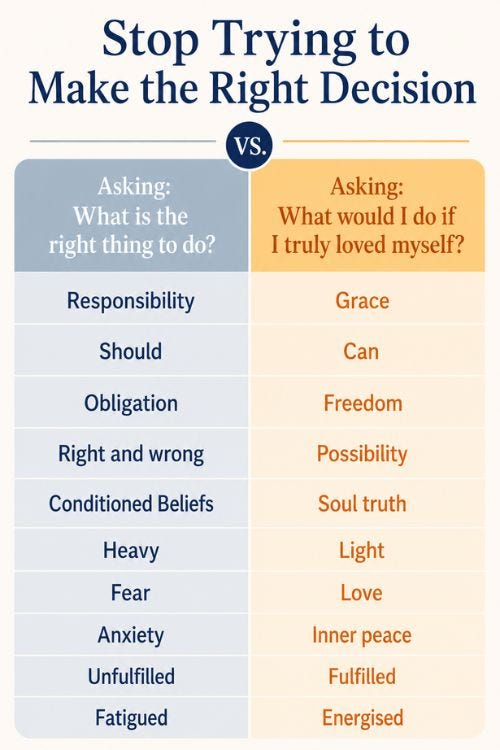
The next time you find yourself trapped in endless overthinking, remember that your goal is not to discover the one perfect decision. There probably isn't one. Instead, your goal is to make a decision that is true to you. When you stop asking, "What is the right thing to do?" and begin asking, "What would I do if I truly loved myself?" you shift from living by obligation, fear and other people's expectations to living from self-respect, inner peace and authenticity. Your rational mind still has an important role to play, but it works best when it is supporting your deepest values rather than trying to define them. That simple shift won't remove every difficult decision from your life, but it can make decision-making feel lighter, clearer and far less exhausting.
Just One Thing
The Just One Thing action point challenge I have for you is to try this out with a small life choice that you experience today. Start with something simple and see how it works for you. That may be something like deciding whether or not to have a bag of chips for an afternoon snack, choosing what to wear for the day or whether to stay at home or go to your exercise class. These are all types of small decisions we commonly face on a day to day basis where we often get stuck in “shoulds” or going back and forth between what we want and what we think would be the “right” thing to do.
Instead...
pause for a moment.
Take a breath.
And ask yourself,
"What would I do if I truly loved myself?"
I would love it if you let me know in the comments what happens for you when you try this.
Like what you’re reading? Subscribe to my Midlife Made Easy weekly newsletter and get more great support to help you slow down, feel better and enjoy midlife more - one simple step at a time
Aroha nui, much love
Janine
Frequently Asked Questions
Why is it so hard to make decisions in midlife?
Decision-making often becomes harder in midlife because we are juggling more responsibilities while also going through significant life changes. Career transitions, changing family roles, menopause, ageing, divorce or children leaving home can all affect our sense of identity. When we're no longer clear about who we are or what we truly want, making decisions naturally becomes more difficult.
Why do I overthink every decision?
Overthinking often happens because we're trying to find the one "right" answer. We worry about making mistakes, disappointing others or regretting our choice. In reality, there is rarely one perfect decision. Constantly searching for certainty can leave us stuck in an exhausting cycle of analysing every possible outcome.
Is there really a "right" decision?
Most life decisions don't have one objectively right answer. What feels right depends on your values, circumstances and priorities. Instead of searching for the perfect decision, it can be more helpful to make a decision that is aligned with who you are and what matters most to you.
How can I stop overthinking decisions?
One simple approach is to change the question you're asking yourself. Instead of asking, "What is the right thing to do?" try asking, "What would I do if I truly loved myself?" This shifts your focus away from fear, obligation and other people's expectations, and towards your own values and wellbeing.
What does it mean to make a decision from self-love?
Making a decision from self-love doesn't mean doing whatever feels good in the moment or ignoring other people. It means choosing from a place of self-respect, honesty and compassion. Once you're clear about what feels true to you, your logical mind can help you work out the best way to put that decision into practice.
What is heart-brain coherence?
Heart-brain coherence is a state where the rhythms of the heart and brain become more synchronised. Research suggests that positive emotions such as love, gratitude and compassion can promote this state, supporting clearer thinking, better emotional regulation and greater resilience. This is one reason why beginning with a calm, loving mindset may help when making important decisions.
How can I trust myself to make better decisions?
Self-trust grows through practice. Start by making small everyday decisions that reflect your own values rather than what you think you "should" do. Each time you honour your own truth, you strengthen your confidence in your ability to make decisions that are right for you.
What is the best question to ask when making a difficult decision?
If you find yourself caught in overthinking, ask yourself:
"What would I do if I truly loved myself?"
This simple question can help quieten mental noise and reconnect you with what feels authentic, allowing your logical mind to support your decision rather than control it.