
Listen to the podcast version of this article here
Have you ever found yourself feeling frustrated that someone didn't help, didn't notice, or didn't do something that seemed completely obvious to you? Perhaps you've thought, "If they really cared, they would just know." The truth is, even the people who love us most cannot read our minds. One of the simplest yet hardest skills in healthy relationships is learning to ask clearly for what we need. For many of us, asking feels uncomfortable because it stirs up fears of rejection, conflict or being seen as needy. Yet when we don't ask, our needs often go unmet, resentment quietly grows, and relationships become harder than they need to be. Learning to ask isn't about becoming demanding. It's about becoming honest, clear and connected.
How I Became a People Pleaser
Apparently I was quite feisty as a young child. My auntie would tell me stories of the arguments that I used to have with her. In my pre-teens I loved public speaking and debating. I was free spirited and free speaking. By puberty, life had knocked most of that out of me and I became full of fear: fear of rejection, fear of being told off, fear of getting things wrong, fear of being judged and fear of disappointing people. I became a people pleaser. I became compliant. I became accommodating.
I learned to rely on myself and to be resourceful. I would take on all sorts of things by myself and go without all sorts of things because I felt so uncomfortable asking people for anything.
When I had children that shifted a little because often I needed to get things as efficiently as possible. For example, I would walk into a store and go straight up to someone who worked there and ask for what I wanted, because I didn’t have the time or energy to browse stores trying to find things myself. Even so, while I felt okay to ask for things for my children, I still didn’t feel okay to ask for things for myself.
I would brush off offers of help or support. Not that there were that many because I appeared so self-sufficient. I had a big fear of being seen as a “nagging wife” so I avoided asking my husband to do things and would just do everything myself.
Then, in my early forties I crashed. First my body collapsed under all the stress I had been experiencing (and creating). Then, my second marriage collapsed and along with it, the life I had known for about fifteen years, but I still tried to struggle along without asking for help.
Why is it So Hard to Ask for What You Need?
For most of us growing up in Western society we are not taught how to ask, in fact we are often taught not to ask. We are told or learn through experience that asking is impolite, annoying or a sign of weakness or ignorance. We become fearful of being rejected, ridiculed or disappointed. To avoid those uncomfortable feelings we refrain from asking for things in case the answer is no. We begin to attach all sorts of meanings to the act of asking and it becomes tied to a lot of uncomfortable emotions.
It is also tied to unworthiness, which keeps us from allowing ourselves to receive. In my mid-forties when I began my journey to learn to truly love myself, one of the first things I noticed as I began to feel a greater sense of self-worth, was that I began to feel much more comfortable asking for and receiving help.
15 Common Reasons We Avoid Asking for Help or Support
Most of us don’t avoid asking because we don’t need anything. We avoid asking because we’ve learned that asking feels emotionally risky. Over time we develop beliefs that make it easier to stay silent than to speak up. Here are some of the common reasons why we avoid asking for things:
-
We don’t want to be a burden.
-
We don’t want to seem needy.
-
We don’t want to be seen as bossy, nagging, demanding or controlling.
-
We don’t want to start an argument.
-
We don’t want to be rejected.
-
We don’t want to disappoint other people.
-
We don’t want people to think we’re weak or incapable.
-
We feel guilty putting our own needs first and don’t want to look selfish.
-
We think it is obvious what needs to be done (especially when it comes to household jobs)
-
We assume other people should already know what we need (”If they loved me, they’d just know”)
-
We believe that if we have to ask then it somehow makes the response less genuine.
-
We’ve learned to rely only on ourselves.
-
We don’t believe we’re worthy of receiving help.
-
We fear owing someone something in return.
-
We don’t want to inconvenience anyone.
-
We’ve been criticised or rejected when we’ve asked before.
-
We think it’s easier just to do it ourselves.
If you look at that list, most of those things are beliefs that are based on assumptions or negative past experience. They are what we can call stories rather than truths. They can be challenged - this is what I believe, but is it really true? For example, let’s look at the fear of someone saying “no” to our question, which is also usually a fear of rejection. If you look at it logically and objectively, whether someone replies “yes” or “no” is just an answer to a question. It is just information, but we as humans, through our lifetime of painful experience, attach deep emotional meaning to someone saying “no” to us. Even in a dating situation, if you ask someone out and they say “no”, then okay, you are probably going to feel disappointment, but their response is actually just information about their preferences and not an indication that you are inherently unworthy or inadequate. The story we tell ourselves is that rejection means that we as a person are not good enough, when it actually is just someone’s response based on what they personally do or do not like. Learning to separate those two things is incredibly freeing, because once we stop attaching our worth to other people’s responses, asking becomes much less frightening. We can begin to see it more as simply an honest conversation.
The Hidden Cost of Not Asking for What You Need
One way to manage our limiting beliefs and stories about asking is to reflect on if they are rationally true. We can also ask if they serve our highest good, because asking is a key part of learning, growing, receiving and being in meaningful relationships with others. Not asking and avoiding asking can actually have significant negative consequences such as:
-
We become exhausted from doing everything ourselves.
-
We build resentment toward people who didn’t even know we needed something.
-
Our relationships become one-sided.
-
People assume we’re coping because we never say otherwise.
-
We miss opportunities to receive love and kindness.
-
We feel lonely, even when surrounded by people.
-
We become overwhelmed.
-
Small frustrations build into major conflicts.
-
We expect others to read our minds.
-
We rob other people of the opportunity to help us.
-
We reinforce the belief that we have to do everything alone.
-
We become less connected to the people we love.
-
Our needs remain unmet.
-
We model unhealthy relationship patterns to our children and grandchildren.
-
We slowly lose our voice.
Why Not Asking Creates Conflict in Relationships
It is ironic that one of the main reasons people hold back from asking for things is because they want to avoid conflict, but in actual fact not asking is itself a significant cause of conflict in personal relationships. One of the main reasons we get annoyed with people is because they trespass one or more of our needs or values. This is frequently done unintentionally and unknowingly because we haven’t asked for that need to be met or that value to be respected. In a similar way, we get annoyed when people haven’t met one of our expectations, but we often haven’t clearly asked for that expectation to be met. We tend to think that the people closest to us will know us so well that they will be able to identify for themselves what we expect, need and want. However, no matter how much we love someone or even how empathic we are, no one that I know of in real life is a mind reader. In addition to that, while you may think that you and your “soulmate” are on the same wavelength about everything, you are not. Everyone has their own unique thoughts, feelings, experiences, perspectives, beliefs and blind spots. What that boils down to is, “I don’t know what you really want unless you ask me.”
How to Ask for What You Need in a Healthy Relationship
Okay, so we’ve established that asking is important, but then how do you do it in a way that works. How do you actually ask for what you need in a way that feels respectful, honest and effective? I understand the fear of asking on a deep personal level. I get that it can seem really hard. I know how words can seem to stick in your throat, come out wrong or not get the response you were hoping for. I also know from experience that practice and having a simple script or framework to follow can really help. If you find it hard to ask other people for things, then start practicing with small requests that don’t have a lot of emotional charge for you or the other person. This will help you to become more comfortable with asking for support and assistance which will build your confidence to start making requests about your deeper desires and emotional needs.
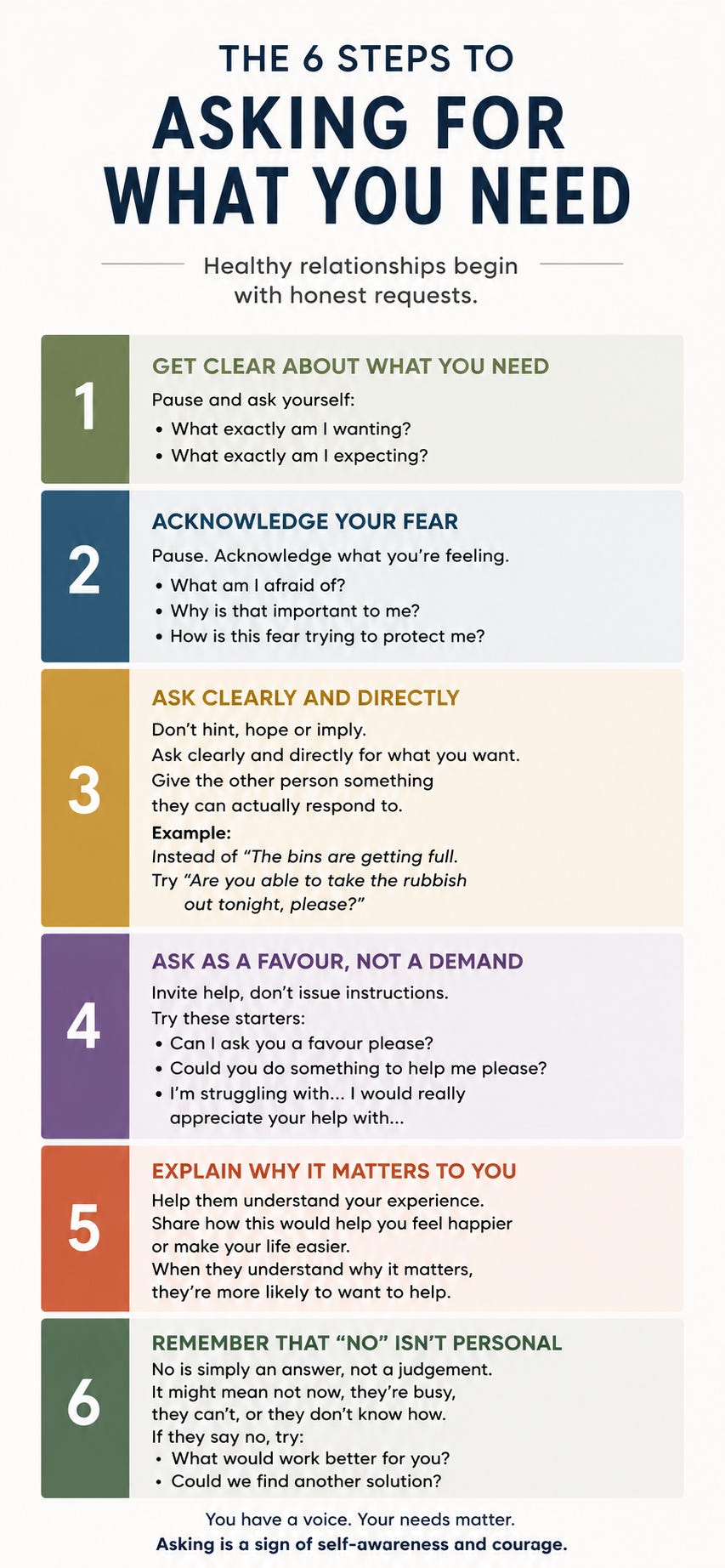
Below is a simple series of steps that you can use to effectively make simple everyday requests.
Step 1: Get Clear About What You Need
If you are not clear about what you want, then other people won’t be either. When our needs are not met we often feel upset or frustrated and we get caught up in the emotion. Emotions also get stronger the more we put off asking for what we want, and then all sorts of other stories start to cloud our thinking, or we get more tired and stressed from doing everything ourselves instead of asking for help. As soon as you feel frustration, upset or stress starting to churn, pause, breathe and ask yourself:
“What exactly am I wanting?” or
“What exactly am I expecting?”
This will help you to understand for yourself what you actually want, need or expect, which is valuable self-awareness. It will also enable you to make a clear request to someone else.
Step 2: Acknowledge Your Fear Before You Ask
Most personal development advice focuses on overcoming fear through willpower and force. I approach fear differently because I believe that what you resist, persists. If you try to ignore your fear (or any other uncomfortable emotions that you have at the thought of asking for something) then you are just trying to squash that energy down and lock it away somewhere in your body. The energy of that fear is still there triggering your body into a stress response and when you are in stress, the emotional part of your brain takes over from the rational part. What I do instead is to take a moment to acknowledge my fear, I open to what I am feeling and what is underneath it. To do this you can ask yourself questions like:
What am I afraid of?
In what way is that important to me?
How is my fear trying to protect me and keep me safe?
When you acknowledge your fear and understand how it is trying to protect you, then it quiets. It may still be there, but as a warning light rather than a blaring fire alarm. If you want to physically release the energy of it from your body even more, then you can try shaking out your arms or going for a walk. Moving your body physically can be a very effective way to move your emotional energy. However, I think that it is helpful to also get the information of what you are feeling and what thoughts, beliefs and needs are stimulating that feeling for you. Again, this gives you valuable self-awareness information.
Step 3: Ask Clearly and Directly
Instead of hinting or hoping, make a clear request. Dropping hints is equivalent to expecting someone to read your mind or intuitively know what you want. We usually drop hints because we are afraid to ask for something directly. I understand that fear. and that asking can feel hard. I also know that hinting is an ineffective strategy and almost never achieves the outcome that you want. Ask clearly and directly for what you want. For example, instead of saying:
“The rubbish bins are getting pretty full.”
Make a direct request like:
“Are you able to take the rubbish out tonight please?”
The other thing about direct requests are that they give really clear direction to the other person. This means that the other person is not left wondering what you meant when you said that or what you expect or want, and then making assumptions about what you are thinking and feeling. Asking clearly and directly saves you both from a lot of unhelpful over-thinking.
Step 4: Ask as a Favour, Not a Demand
Asking for a favour feels easier for most people. It is less formal. Compare the energy of “Can I ask you to do me a favour please?” with “Can you do something please?” or “I need something from you”. Most people are not rattled when someone asks them for a favour, whereas the the other two statements tend to stimulate a sense of defensiveness in most people - like they need to brace for something big and potentially demanding of them. The underlying energy of asking for a favour is that you are giving someone the opportunity to help you rather than directing them to do something you think they need to do. Most people don’t like being told what to do and will push against it in some way. However, generally, the people who love you want to help you in whatever way they can, and asking in this way gives them an opportunity to do that.
You could use the following starter scripts:
“Can I ask you a favour please?”
“Could you do something to help me please?
“I’m struggling to . . .[specific problem] I would really appreciate your help with . . . [specific way they can help]
Coming back to the value of being clear, being specific about what the other person can do to help you makes it easier for them because they don’t have to try and work out what to do or what you want.
Step 5: Explain Why It Matters to You
This builds on the energy of asking in a way that gives someone the opportunity to help you. Most of us want to make the people we love happy, so if they understand how doing this “favour” for you will help you feel better or make life easier for you, then the request will land with them with less friction. In other words, they will be less likely to get defensive or say no either directly or by avoiding actually doing it. Again, we often think that how something will help us is obvious to other people because it is obvious to us, but remember, other people are not us. They don’t know what we like unless we tell them. Telling someone how doing this thing for you will enable you to feel better or make life better for you, helps it to make sense to the other person. They may not personally think it is important to do that thing, but when they understand how it is important to you, then that becomes a reason it is important to them.
6. Accept That the Response is Simply Information.
Remember that "No" isn't personal. If someone says “no” to your request, it doesn’t mean you’re unlovable, don’t matter or have done something wrong. You have simply asked a question and they have given you their response. People say “no” to a request for all sorts of reasons, and most of those reasons are about their circumstances, preferences and priorities rather than your worthiness. A “no” response could mean:
-
Not now.
-
I’m tired.
-
I already have other commitments.
-
I don’t know how to do that or
-
I can’t do that
If someone says “no” to your request and doesn’t give you a reason or alternative, then avoid asking “why?” because that can feel confrontational or put someone on the spot if they don’t know how to do what you are asking for or don’t have the skills to do it. Instead, you could ask a follow-up question like:
“What would work better for you?” or
“Could we find another solution?”
These questions use curiosity to open a conversation about how this problem can be solved without putting pressure on anyone. They invite collaboration and communicate that you would like to look for a solution together.
Healthy Relationships Begin with Honest Requests
Healthy relationships are not about one person getting their own way, they’re about two people working together to understand one another and find a way forward where both people’s needs are being met. Building meaningful relationships involves approaching our relationships with curiosity instead of assumptions, with honesty instead of hinting and with clear requests instead of silent expectations.
Learning to ask is one of the kindest things you can do for yourself and for the people you love. It removes guesswork, prevents resentment and creates opportunities for understanding while preventing misunderstanding. The more clearly you communicate your needs, the easier it becomes for others to support you. Remember, asking is not a sign of weakness or selfishness, it is a sign of self-awareness, courage and healthy relationships. Every time you choose honest communication over silent expectation, you strengthen your relationships and make life a little easier for everyone involved. After all, healthy relationships aren't built on people guessing what we need. They're built on people feeling safe enough to ask, and caring enough to listen.
Just One Thing
Here’s my Just One Thing action point for you this week, I invite you to take a moment to reflect on this question:
What is one thing you’ve been hoping someone would notice, that you haven’t actually asked for?
You don’t have to answer that right away
Just be curious and let it sit with you
Sometimes one honest answer to one simple question can begin to change a relationship.
It can begin to change the relationship you have with yourself.
Aroha nui, much love
Janine
Like what you’re reading? Subscribe to my Midlife Made Easy weekly newsletter and get more great support to help you slow down, feel better and enjoy midlife more - one simple step at a time
Key Takeaways
- Asking is a skill that becomes easier with practice.
- Clear requests prevent resentment and misunderstandings.
- Most people cannot meet needs they don't know about.
- A "no" is information, not a judgement of your worth.
- Healthy relationships are built on honest communication, not mind-reading.
- Start by making one small request this week.
Frequently Asked Questions
Why is it so hard to ask for what I need?
Many people find asking difficult because they associate it with uncomfortable emotions such as rejection, criticism or disappointment. Over time we can develop beliefs that asking is selfish, annoying or a sign of weakness. These beliefs often come from past experiences rather than present reality. Learning to ask begins with recognising those beliefs and replacing them with healthier ways of thinking.
Why do I feel guilty asking for help?
Feeling guilty often comes from believing that you should be able to cope on your own or that asking makes you a burden to others. In reality, most people enjoy helping someone they care about when they know what is needed. Allowing others to help is not a sign of weakness—it creates opportunities for connection and strengthens relationships.
How do I ask for what I need without feeling selfish?
Start by reminding yourself that your needs matter just as much as everyone else's. Being honest about what you need is different from making demands. A healthy request respects both your needs and the other person's freedom to say yes or no. Clear communication is an important part of every healthy relationship.
What is the best way to ask for something in a relationship?
The most effective approach is to be clear, specific and respectful. First, become clear about what you need. Then ask directly rather than hinting or expecting your partner to guess. Explain why your request is important to you and remember that you are making a request, not a demand.
Why do I expect people to know what I need?
Many of us unconsciously believe that if someone loves us, they should automatically know what we want. The reality is that even people who know us well cannot read our minds. Healthy relationships are built on honest communication, not assumptions or mind-reading.
What should I do if someone says no?
Try to remember that "no" is simply an answer to your request, not a judgement about your worth. People say no for many different reasons, including being tired, busy or unable to help at that time. If appropriate, stay curious and ask questions such as, "What would work better?" or "Could we find another solution together?"
How can I become more confident asking for what I need?
Like any skill, asking becomes easier with practice. Start with small requests that feel safe and low risk. Each positive experience helps build confidence and gradually changes the beliefs that have made asking feel uncomfortable in the past.
Why do unmet expectations cause conflict in relationships?
Many relationship conflicts begin when we expect other people to meet needs or expectations that we have never clearly communicated. When people don't know what we need, they can't intentionally meet those needs. Clear requests reduce misunderstandings, resentment and disappointment while creating stronger, more supportive relationships.
Is asking for help a sign of weakness?
Quite the opposite. Asking for help requires honesty, vulnerability and courage. It demonstrates self-awareness and gives other people the opportunity to support you. Healthy relationships depend on both giving and receiving support.
What is the most important thing to remember about asking?
Remember that asking is simply honest communication. It isn't about being demanding or controlling—it's about giving people the opportunity to understand your needs. Healthy relationships aren't built on people guessing what we need. They're built on people feeling safe enough to ask and caring enough to listen.