
What Does It Really Mean to Live Authentically?
Listen to the podcast version of this article
Have you noticed yourself caring less about what other people think as you’re moving through midlife? Perhaps you've started setting firmer boundaries, saying no more often, or questioning whether the life you've spent years building is actually the one you want. Many people describe this stage of life as becoming "more authentic" or "finally being true to themselves," but what does that actually mean? Is authenticity simply caring less about other people's opinions, or is something much deeper happening? I believe that midlife gives us a unique opportunity to peel back the layers of conditioning, expectations and roles we've accumulated over the years, and reconnect with the person we are underneath the masks we have worn. Before we can do that, though, it helps to clear up a few common myths about what living authentically really means.
3 Common Myths About Living Authentically
Myth 1: Does Speaking Your Truth Mean Saying Everything You Feel?
Let’s begin with dispelling a common misconception about what it means to “speak your truth”. Something that is repeatedly seen in the media at the moment is where speaking your truth is shown as being freely expressing your thoughts and emotions without holding anything back. Speaking your truth is not venting your thoughts and emotions, and feeling authentically does not mean letting your emotions run the show. Your emotions are not your truth. What is underneath the emotion is closer to your truth. From an evolutionary perspective, emotions developed to give us information and motivation. Emotion is your brain telling you something and motivating you to respond to that information. To discover what your truth is, it is helpful to ask yourself: “What is this emotion telling me? Why do I feel this?” The emotion is a signal. What is it signaling?
Myth 2: Does Living Authentically Mean Setting More Boundaries?
The second misunderstanding that I often see in media is where people confuse living authentically with another thing that happens for many people in midlife, which is that our tolerance for BS shrinks. The two can be related, but they are not the same thing. Creating a boundary because you have made a loving and conscious decision that something is no longer serving your wellbeing, is very different from saying “no” to things because you can’t be bothered dealing with them any more.
Most of us have reduced capacity in midlife. It results from decades of managing multiple responsibilities, problems and organizational loads. By our forties, the majority of us have bodies that are functioning in survival mode because of ongoing stress. Couple this with the effects of body wear (aging) and hormonal changes and we end up like an old cell-phone that never gets fully recharged, has a battery that drains quickly, and which can barely run the apps it has loaded let alone download new ones. In that state, being honest feels like telling the world it can just “F*^k off”.
While this may feel like your truth, authenticity is not actually linked to what you won’t tolerate anymore. It is linked to your joy. Telling the world to “F” off after decades of running yourself ragged looking after everyone else may feel empowering, but it is not being true to yourself. Your authentic self is who you are when you are fully connected to love, appreciation, peace and joy. It is who you are when you are fully relaxed, and not just being more strongly reactive.
Myth 3: Are Your Personality Traits Really Who You Are?
The third myth that I would like to address is that many people believe that the common personality traits that they exhibit are “just who they are”. That is not entirely true. I believe that there are some personality tendencies that we are born with, but most are learned. We learn behaviours and the beliefs that anchor them, from mirroring the people we grew up with. We also develop a lot of behaviours based of what we think we need to do to hide, perform or please in order to survive.
What Is the Difference Between Your Ego and Your Authentic Self?
All of the aspects of our personality that I mentioned above are connected to a part of us that we can call the ego. You can think of your ego as being like your storefront. It is the part that you package, present and market to the world and which develops to allow you to function in the world. It is the roles that you play and the behaviours that you perform. It is the conditioning that you take on from other people, society and media about how to behave, what is right and wrong, and what you need to have. Our ego is also what drives us to compare ourselves to others and to want to achieve things. Your ego is the part of you that wants to prove your ability and worth, and which seeks approval and validation from others.
Some people talk about the ego as a bad thing, but I think it is simply one part of our mind; one part of our awareness. It helps us to function in the world and we can’t participate in everyday life without it. However, it is not your true self, and a key part of personal growth is learning to identify what is attached to your ego, and who are you underneath that. Who you are underneath your emotions, your behaviours, your roles and even your thoughts, is your true self.
I think this is what many people do mean or want in midlife when they talk about living more authentically. It’s this shedding of the old identity that we built to please other people and follow society’s definition of success, but which we realise didn’t actually satisfy us or make us happy. It’s the desire to be and do the things that you have been putting on hold - the things that have lived under the surface for years because they didn’t fit the “storefront” the outside world was directing you to be. It’s the realisation that you have been living your life for someone else and building someone else’s dream, rather than your own.
How Do You Know Who Your True Self Is?
I often talk about living in alignment with who you truly are, but how do you know who you truly are? In order to understand what your true self is, it is helpful to clarify what it is not, as well as what it is.
What is not your true self:
-
anything that comes from comparing yourself to someone else
-
anything that comes from achieving a level of performance or recognition
-
anything where you are trying to prove something
-
anything that comes from pleasing others
-
anything that comes from fear - including to hide parts of yourself or limit yourself in any way
What is your true self?
-
who you are when you are operating from deep self-acceptance, self-love and self-respect
-
who you are when you don’t need to prove or explain yourself to anyone
-
what energises you from your centre core outwards
-
what comes from a place of love as pure, positive energy
The Three Parts of Yourself: Conditioned, Protective and Authentic
I think that it is also helpful to break this down further and categorise it in terms of three parts of ourselves: The Conditioned Self, The Protective Self and The Authentic Self. We can connect The Conditioned Self and The Protective Self to the ego, and The Authentic Self to our true self. I like this framework because it shows that each of the different aspects play a part in helping us function in life. They are all valid. I think that personal growth is not about getting rid of any of these parts of ourselves, but rather understanding how and when each one is operating. That understanding gives us more choice in terms of how we live our life.
The Conditioned Self
The person we’ve learned to become.
Formed through...
-
family
-
school
-
culture
-
expectations
-
fear
-
success
-
basic survival
This self asks: “What do I need to do to be accepted?”
The Protective Self
The habits we developed to keep ourselves emotionally safe.
Examples:
-
people pleasing
-
perfectionism
-
overachieving
-
controlling
-
avoiding conflict
-
staying busy
-
never asking for help
These aren’t who we are. They’re protective strategies.
The Authentic Self
The person underneath all of that.
The person who naturally values...
-
curiosity
-
kindness
-
honesty
-
creativity
-
humour
-
calm
-
generosity
-
adventure
-
connection
This is the authentic self we desire to reconnect with in midlife.
How Can You Discover Your Authentic Self?
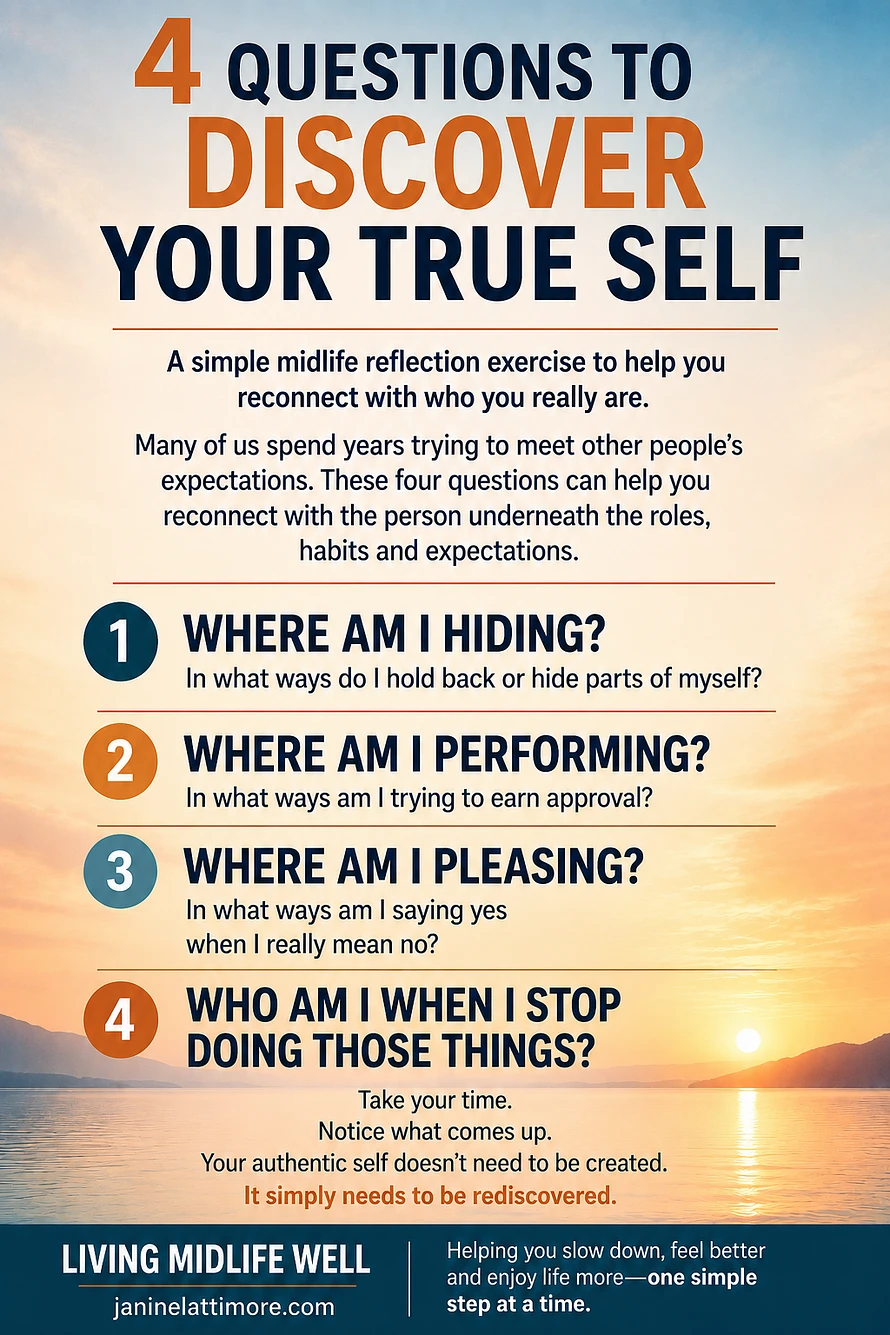
Now that we have clarified conceptually what your true self is, the next question is how do you connect with your own personal authentic self. Again, it is helpful here to start with identifying how you are not being true to yourself. To begin doing that you can ask yourself questions 1-3 below to help you identify where you are hiding, performing or pleasing. The information from those first three questions will help you answer the last one and identify your true self.
I invite you to take your time with these. Let the first three questions sit with you over a few days or more as you observe what you are thinking, feeling and doing as you move through your daily life. Holding these questions in your mind may help you to notice things about yourself that you hadn’t noticed before. I also encourage you to write down your responses and observations. Writing things down helps you to externalize your thoughts and see things from a different perspective.
Four Questions to Help You Discover Your Authentic Self
Where am I hiding?
In what ways do you hold back or hide parts of yourself?
Where am I performing?
In what ways are you trying to earn approval?
Where am I pleasing?
In what ways are you saying yes when you really mean no?
Once you have the information from reflecting on those questions, ask yourself this to identify your true self:
Who am I when I stop doing those things?
What Does It Mean to Be True to Yourself?
Being authentic isn’t about becoming someone different.
It’s about removing everything that isn’t really you.
It’s letting go of the roles you’ve been playing for decades.
It’s making decisions that align with your values instead of your fears.
It’s choosing what brings peace rather than what wins approval.
It’s connecting to your joy.
It’s appreciating your innate talents and interests.
It’s recognising your own beauty.
It’s flowing in your creative energy.
It’s coming home to yourself.
Just One Thing - One Simple Practice to Become More Authentic
My “Just One Thing” action point invite for you this week is to notice what emotions you feel today and to see them as a signal rather than who you are. To do this, when you feel something, name it as an experience you are having and then be curious about what it might be signaling to you.
For example, if you feel sadness
-
Name the experience using the phrase, “I am feeling . . .”
I am feeling sadness
-
Ask yourself: “What is this emotion telling me about what I want or need?”
Recognising that you are not your feelings, but rather that your feelings are something you experience, is an easy first step to becoming more self-aware of your true self.
If you have any comments or questions in response to this post then I would love to have a conversation with you about them in the comments.
Like what you’re reading? Subscribe to my Midlife Made Easier newsletter for more great tips on how to slow down, feel better and enjoy midlife more—one simple step at a time
Aroha nui, much love
Janine
Frequently Asked Questions About Being True to Yourself
What does it mean to be true to yourself?
Being true to yourself means living in a way that reflects your own values, interests and inner wisdom rather than being driven by fear, people-pleasing or the need for approval. It isn't about becoming someone different. It's about reconnecting with the person you already are underneath the roles and expectations you've accumulated throughout life.
What does it mean to live authentically?
Living authentically means making choices that feel aligned with who you really are. Rather than constantly trying to meet other people's expectations, you begin making decisions that support your wellbeing, bring you joy and reflect what matters most to you.
Why do so many people want to live more authentically in midlife?
Midlife often brings a natural period of reflection. After years of meeting responsibilities and following expectations, many people begin asking deeper questions about how they want to spend the next stage of their lives. This can create a strong desire to let go of old roles and reconnect with what feels meaningful and true.
Is setting boundaries the same as being authentic?
Not necessarily. Healthy boundaries are an important part of looking after yourself, but authenticity goes beyond simply saying "no." Authenticity is about understanding why you are making your choices and ensuring they come from self-awareness rather than exhaustion or emotional reactivity.
Are my emotions my truth?
Emotions are important, but they are not your truth. They are signals that provide valuable information about your experiences and needs. Instead of reacting immediately to an emotion, it can be helpful to become curious and ask, "What is this emotion trying to tell me?"
What is the difference between my ego and my authentic self?
In this article, the ego refers to the part of us that develops to help us function in the world. It includes our roles, learned behaviours, desire for approval and the ways we adapt to fit in. Your authentic self is the part of you that exists underneath those learned patterns—the part that naturally expresses your values, interests and unique way of being.
How do I know if I'm living according to other people's expectations?
You may notice that you often seek approval, compare yourself with others, say yes when you really want to say no, or make decisions based on what you think you "should" do rather than what genuinely feels right for you. Becoming aware of these patterns is often the first step towards greater authenticity.
How can I reconnect with my authentic self?
A good place to begin is with gentle self-reflection. Ask yourself:
- Where am I hiding parts of myself?
- Where am I performing to gain approval?
- Where am I people-pleasing?
- Who am I when I stop doing those things?
You don't need to answer these questions immediately. Simply holding them in your awareness can help you notice patterns and begin reconnecting with yourself over time.
Can I become more authentic at any age?
Absolutely. While many people experience this shift in midlife, authenticity is not limited to a particular age. At any stage of life, greater self-awareness can help you make choices that are more aligned with your values and the person you want to be.
What is one simple step I can take today to become more authentic?
The easiest place to begin is by becoming curious about your emotions rather than being controlled by them. When you notice a strong feeling, pause and ask yourself, "What is this emotion trying to tell me?" That small habit can help you develop greater self-awareness and gradually reconnect with your authentic self.