
Why You Feel Like There is Never Enough Time
Listen to the podcast version here
Do you ever get to the end of the day and wonder where all your time went? You may have been busy from the moment you woke up. You answered messages, dealt with other people’s needs, worked through your list, did the things that needed doing and perhaps even squeezed in a few things you thought you should do. Yet, somehow, the things that mattered most to you didn’t get much of your time at all.
For years, I thought my problem was that I didn’t have enough time. What I’ve come to realise is that the problem wasn’t really time. It was what I was choosing to give my time to.
If your days are organised around everything that is urgent, expected, requested and necessary, there will always be more to do. The question isn’t how you can fit everything into your day. It’s whether the things filling your day are actually the things you want your life to be made of.
Do you get up in the morning and just launch into responding to other people‘s needs and calls for attention, and doing what you think needs to be done? Is checking your messages, email and social media on your phone the first thing that you do when you wake up? Are you constantly responding to what is urgent? Does your to-do list start forming in your head the moment your eyes open from sleep (or even in your dreams)?
I don’t ask those questions from a place of judgement. I ask them from a place of curiosity, and I invite you to do the same.
If you can identify with any of that, then here is my next question for you:
How does it feel to live that way?
For me it felt -
overwhelming
stressful
like I was constantly rushing
and running on a daily grind treadmill
It felt like there was never enough time.
Can you relate to any of that? If so, I am going to share one simple idea in this article that can help.
Stop Prioritising Your To-Do List and Start Prioritising Your Life
One of my favourite quotes from Steven Covey, author of The 7 Habits of Highly Effective People, is
The key is not to prioritise what‘s on your schedule,
but to schedule your priorities.
I love this idea because it sounds like a small distinction, but actually it’s quite a profound one. Prioritising what is on your schedule is about organising what is on your to-do list. Scheduling your priorities means consciously choosing what goes on the list in the first place.
Why Traditional Time Management Doesn’t Always Work for Life
To-do lists normally form around responsibilities, demands, requests, needs and what is urgent. They are normally compiled in response to the world around us. Task checklists have a way of snowballing, once they start rolling they tend to pick up any other task that needs to be done and we don’t usually stop to prioritise what is going on the list, we just organise how the list will be completed in relation to time. That is why to-do lists have a habit of becoming very long, sometimes even unending, and we feel like we are running on mouse wheel trying to keep up with getting everything done.
The most common methods for prioritizing tasks still work from this same principle of organising what the world is asking of you. For example, the following methods are all still largely focused on tasks that are urgent, important and must be done.
-
The Eisenhower Matrix: Divide tasks into four boxes: Do first (urgent and important), Schedule (important, not urgent), Delegate (urgent, not important), and Delete (neither).
-
The ABCDE Method: Label tasks from A (must-do, high consequence) to E (eliminate) to focus on what truly moves the needle.
-
The 2+8 Rule: Pick just 2 must-do tasks and 8 should-do tasks the evening before so you start your day with clear focus.
Why Focusing on Urgent and Important Tasks Can Leave You Unfulfilled
I’m not saying the above methods are bad. They can be very useful, particularly when you’re organising work and trying to manage a large number of tasks. However, if you organise your personal life this way, you are likely to feel dissatisfied, unfulfilled and disconnected from yourself. That is because this way of thinking is centred around responding to what is happening in the world, rather than creating your life in terms of how you want it to structured, and possibly more importantly, how you want it to feel.
Living in response to everything around us often leads to a sense of there being no “you” in your life. It can result in a strong desire to escape your life, usually through things that temporarily help us feel good like sweet food, alcohol, drugs and impulse buying. When your life is constructed solely around all the things you must do, have to do, are responsible for, are urgent or are asked of you, then it is understandable if you procrastinate and avoid tasks, or feel anxious or depressed.
A Better Way to Prioritise Your Time: What Do You Actually Want?
One way that I have come up with to shift this, is a system that works more on scheduling your priorities. The key difference with this system is that I include a category that I haven’t seen on any other scheduling system - what you want to do. This category is probably not usually included because it is commonly viewed as selfish and/or unproductive. However, it is the key to feeling fulfilled in your life. You can feel a sense of satisfaction or success in ticking off the boxes for completing urgent, must do and productively or responsibly important tasks, but you will never feel truly fulfilled unless you include your desires in your to-do list.
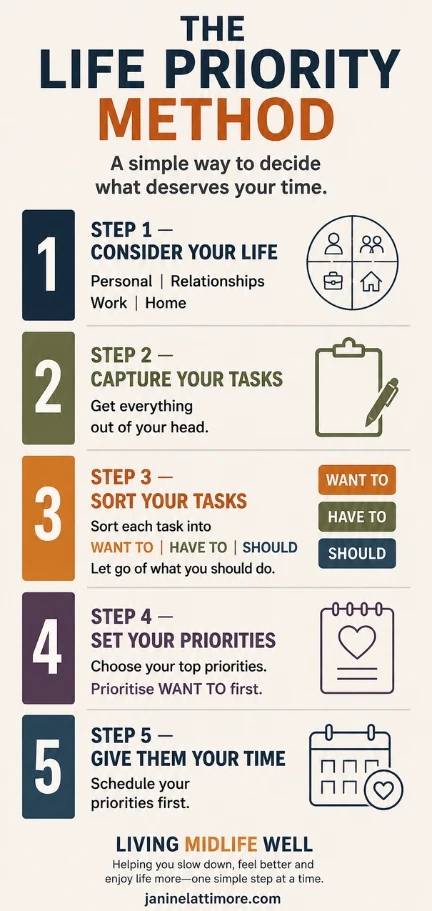
I have named this system The Life Priority Method. Here is how it works.
How to Create a Task Focus List Instead of a To-Do List
Firstly, a language shift, because the language that we use shapes how we think. I like to call a list of action points a task focus list rather than a “to do” list. “To do” sounds like a command. It has a heavy energy of effort and responsibility attached to it. Task focus list has an energy of choice – a sense of “this is what I choose to focus on today.”
There are two parts to creating your daily Task Focus List: categorising and prioritising. For the categorising part we create a category framework to brainstorm all the tasks for the day.
How to Organise Your Tasks for Better Life Balance
To create the Category Framework divide a piece of paper or notebook page into four even rectangles or squares. Give each of these boxes one of the following four life categories as a heading. The reason for this doing this is that thinking about tasks for each of these areas will help you to maintain balance in your life:
The Four Life Categories:
Personal (physical, mental, spiritual)
Relationships and social
Work and finances
Home creation and maintenance
I have included three sub-headings in the personal section: physical, mental and spiritual. These are to prompt you to consider all of these aspects of your personal wellbeing every day. You can interpret “spiritual“ in any way that resonates with you. It includes things like values, connection to nature, meditation, ancestors and heritage, life-force, soul or religious or spiritual beliefs.
Start by Getting Everything Out of Your Head
Once you have this framework drawn up, then brainstorm and write down everything you think you want to do as well as the tasks you think you need to do, have to do, or should do, in each of the four boxes. After you have done that, notice whether some categories have a lot more tasks than others and whether there are areas that you could bring more focus to. You don’t need to try and fix anything at this point. Simply, use it as awareness of ways that you may like to bring more balance into your life.
How to Prioritise Your Tasks: Want To, Have To or Should?
After you have brainstormed all the activities you have in your awareness to do, then colour code each item as being in one of three categories: “Want to”, “Have to” or “Should” i.e “I should do . . .” I find using a multi-coloured pen the easiest way to do this.
Tasks that can be categorised as “want to” are both tasks that you feel interested and excited to do, and tasks that you may not feel like doing, but they are connected to your personal desires. They are tasks that are related to what you are interested in and what you value and what matters most to you. For example, you may not feel like going to your gym class, but looking after your health and connecting socially with people may be a high value for you so it would be a “want to” task even though you may not feel emotionally excited about it.
Make the “want to” tasks into your priority for the day. This is backwards to what we are commonly taught, so it may feel uncomfortable, but give yourself permission to do what you want to do. Prioritise your top three “want to” tasks and schedule them into your day first. If you can do them at the start of the day, then do so to avoid them getting shunted because your time goes to other things over the course of the day.
Then, look closely at the “have to” jobs and decide if you do really have to do it, or whether it can be let go, or delegated to someone else (parents, think about things you are doing for your kids that they could be doing for themselves.) Many times, the things we think we “have to” do - we don’t really have to. Look at your final “have to” list and prioritise the top three. Focus on getting these done second, unless they have to be done at a certain time. Most of us rarely get through all of our daily to do lists. By prioritising the top three way, you know you at least have a good chance of getting the most important things done.
Completely let go of any tasks you have categorised as “should”. Cross them off your list. Whenever we think we should do something, we are responding to the desires and expectations of other people rather than our own. “Shoulds” are not actually your responsibilities to carry or fulfil. Let them go, or assign them to the person who is actually responsible for them. Also, be aware that we often create “shoulds” for ourselves based on what we think will please other people.
How to Put Your Priorities Into Your Daily Schedule
You now have a Task Focus List that is prioritised in terms of what is most important to you, and you can begin scheduling the tasks. Block in the tasks that have to be done at a certain time (like picking up your children from school) and then work through the other tasks in terms of their “want to” and “have to” priority order. Whether you assign set timeframes for each task is up to you. Personally, I find that if I give all my tasks a time schedule, then it creates pressure for me, and stress when I can’t keep to it - which is most of the time. Instead, I schedule by order rather than time; the order I do things in rather that the time I will do things.
I do this on paper because I prefer to be able to see the whole list at a glance and physically cross things off. However, if you have a digital scheduling system that you like using, then you can add your prioritised tasks to that.
What to Do When New Tasks and Demands Come Up
If other tasks or demands come up over the day, think about them in terms of these three categories rather than simply reacting to them automatically. Are they a “Want to”, a “Have to” or a “Should”? This is where the system starts to become more than just a planning exercise. It becomes a way of making decisions throughout the day. Instead of automatically saying yes to every new demand, you have a simple question you can ask yourself before giving it your time.
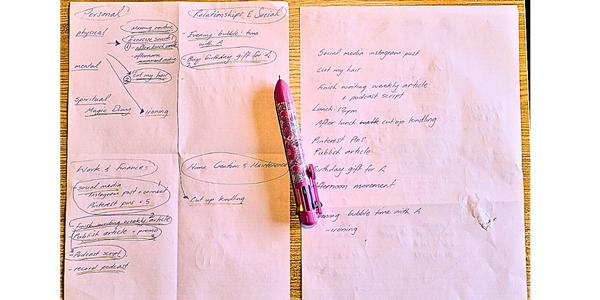
Above is a photo of my planning sheets for the day I was writing this article. The four category framework is on the left and then my ordered schedule for the day is on the right. I use scrap paper for my planning - I find it easier for my neurodivergent brain to freely create and make connections when I am not trying to be tidy. It is the process that is important rather than the prettiness of it, but for those of you who like things to be neat, then I have created a planning template which you can download as a pdf and print off here.
I have also created a phone wallpaper summary which you can also download from the same link.
How Prioritising Your Time Can Reduce Stress and Give You More Energy
This planning process might sound quite complicated, but once you work through it, you will see that it is simple to use and only takes 5-10 minutes. You can do it early in the morning, or in the evening to prepare for the next day which may help settle your mind to sleep by getting the invisible load out of your head. If you are like me, then your active brain just wants to get stuck in to completing tasks and taking time to plan like this feels like time taken away from getting stuff done. However, I know from experience that it is definitely not. It is an investment of t ime that reduces your stress and increases your productivity as well as your level of personal satisfaction and fulfilment. Planning your day in this way gives you clarity and focus. When you are clear and focused you are far more likely to give your time, attention and energy to what truly matters to you. You are also much more likely to receive or achieve your desires. In addition to this, I find that having a clear task focus list that is prioritised in terms of what is most important to me, helps me to be more intentional, and I am less likely to let days pass by doing ‘fluff’ tasks and spending hours being distracted.
Deciding what you want and moving purposefully towards it, sends a clear message for other people to respond to. It also helps you to let go of all the tasks and people that don’t contribute to that. It can act as a foundation which helps you to release expectations and responsibilities that are not in accordance with your authentic self (usually, these are “shoulds”). Additionally, it simplifies your life, reduces the amount of stress you feel, and opens space for creative flow.
Trying to keep an “invisible load” of tasks and responsibilities in your head uses up attention and brain memory and processing space that could be directed to other things. It drains your energy. Using this planning system helps you to reclaim your time and energy and direct them towards looking after yourself and doing what is most important. Putting more “you” into your life increases your level of life satisfaction. This has a bonus effect on your energy because when you feel more fulfilled mentally and emotionally, then you feel more energised, and you are less likely to engage in distracting behaviours which drain your energy like mindlessly scrolling your phone or watching T.V., eating or drinking things that harm your health, or managing your money poorly leading to financial stress.
How to Reclaim Your Time by Focusing on What Matters Most
Reclaiming your time doesn’t necessarily mean finding more hours in the day. It means becoming more conscious about what you choose to give those hours to.
When you stop automatically organising your life around everyone else’s demands, the things that feel urgent, and the endless list of things you think you should do, you create space to ask a more important question: What actually matters to me?
Your time is one of the ways you create your life. When you consciously prioritise the things you want, value and care about, you begin to put more of you back into your days. You will likely still have responsibilities, things that need doing and unexpected demands on your time, but they no longer have to determine the shape of your entire life.
You don’t need to do everything. You don’t even need to fit everything in.
You can decide what matters most—and give that your time first.
Just One Thing
My Just One Thing action point for you this week is to try this planning system out just once and see how you find it.
It may work for you.
It may not.
That’s okay. Either way, I invite you to think about what you learned from trying it out.
I would also love to hear any feedback you have about this planning system. Was it easy to use? What did you like about it? What would you change about it?
If you think it is a great idea, then I would appreciate you sharing it.

Frequently Asked Questions About Reclaiming Your Time
How can I reclaim my time when I feel like there is never enough time?
Reclaiming your time doesn’t necessarily mean finding more hours in the day. It means becoming more conscious about what you choose to give those hours to. Start by looking at everything competing for your attention and ask whether each task is something you want to do, have to do, or think you should do. Prioritising what matters most to you can help you stop automatically giving your time to whatever happens to be most urgent.
What is the difference between managing your time and prioritising your time?
Time management often focuses on organising the tasks already on your list—deciding when and how to complete them. Prioritising your time goes a step further by asking what deserves to be on the list in the first place. Instead of simply trying to fit everything into your day, you consciously choose which activities deserve your time and attention.
Why does my to-do list always seem to get longer?
To-do lists often grow because they are created in response to responsibilities, requests, demands and whatever seems urgent. Once one task is added, other tasks tend to follow, creating an ever-growing list. The problem is that we often spend our energy organising how to complete the list rather than stopping to decide whether everything on it actually needs to be there.
How do I prioritise what really matters to me?
Start by considering the different areas of your life—personal wellbeing, relationships and social life, work and finances, and home. Write down everything you want or need to do, then identify which tasks connect with what you value and what matters most to you. Make your “Want To” tasks your first priorities rather than automatically putting urgent tasks first.
What is a Task Focus List?
A Task Focus List is an alternative to a traditional “to-do” list. The change in language is intentional: “to do” can feel like a command, while “task focus” creates a sense of choice and encourages you to think about what you want to focus on. The list is created by first categorising your tasks and then prioritising them according to what matters most to you.
What are the “Want To, Have To and Should” categories?
The three categories help you distinguish between tasks that are connected to your desires and values (Want To), tasks that genuinely need to be done (Have To), and tasks you feel you Should do because of expectations or perceived responsibilities. The aim is to prioritise your “Want To” tasks first, deal with the most important “Have To” tasks second, and let go of unnecessary “Should” tasks.
How can I stop spending so much time doing things I “should” do?
When you identify something as a “Should”, pause and ask yourself whether it is actually your responsibility. Some “Shoulds” are expectations that come from other people, while others are expectations we have created for ourselves because we think they will please someone else. If the task isn't genuinely yours to carry, consider letting it go or giving responsibility for it to the appropriate person.
How can prioritising my time reduce stress?
Having a clear sense of what matters most can reduce the mental effort involved in constantly deciding what to do next. A Task Focus List gives you clarity and focus, helping you direct your attention and energy towards what is important rather than continually reacting to distractions and new demands.
Do I need to schedule every task at a specific time?
No. You can schedule your tasks by order rather than by exact time. This can be a less stressful approach if tightly scheduling your day creates pressure when things don't go according to plan. Tasks that have to happen at a particular time can still be blocked into your schedule, while other tasks can simply be worked through according to their priority.
How long does it take to create a Task Focus List?
Once you become familiar with the process, creating a Task Focus List should only take around 5–10 minutes. The purpose isn't to spend more time planning; it's to make a small investment of time that gives you greater clarity about where you want to direct your attention and energy during the day.
What should I do when unexpected demands come up during the day?
Rather than automatically reacting to every new request or task, pause and ask whether it is a Want To, Have To or Should. This gives you a simple way to decide whether the new demand genuinely deserves your time or whether it can wait, be delegated or be allowed to go.
Is reclaiming your time about becoming more productive?
Not necessarily. The purpose of this approach isn't to help you squeeze more tasks into your day. It is about making sure your time, attention and energy are being directed towards what truly matters to you. The goal is not to do more—it is to put more of you back into your life.
What is the simplest way to start reclaiming my time?
Start with one day. Write down everything you want and need to do, divide the tasks into Want To, Have To and Should, and then prioritise your top “Want To” tasks first. You don't need to completely change the way you organise your life. Try the process once, notice what you learn, and decide whether it helps you.