
Listen to the podcast version of this on Youtube
Are you constantly busy, but increasingly wondering whether you’re spending your time on the things that actually matter to you? In midlife, our responsibilities can feel bigger, our energy can change, and there can be a growing awareness that our time is finite. If you’re tired of trying to fit everything in and want to create more space for the people, experiences and things that make your life meaningful, this article will help you step back and work out what deserves your time now. You’ll explore three simple questions to clarify what you value, what you love and how you want your life to feel, then bring those answers together into a personal North Star to guide the way you live and use your time.
Why Time Management in Midlife Needs to Be Different
Ask someone in their forties or fifties how they are doing and they will probably say “busy”. This is not a new thing for midlife, most of us have been busy in our lives for years, but busy can hit differently at this stage of life. There are the normal requirements of working full time and looking after a home and then there are some extras. For example, the sandwich generation aspect of more responsibility as we are required to provide care for both our children and our aging parents. Plus, the physical aspect of decreased stamina and energy levels and increased health issues, and the psychological aspect of becoming more aware that our time is finite
Before You Manage Your Time, Decide What Matters
All these factors mean that time management in our forties and fifties needs to look different to what it did in our younger adulthood. Not only is our time possibly more full of responsibilities, but our physical and psychological capacity may be changing. As a result, organising our time in midlife often becomes more about working out what to delete than how to fit more in. The problem isn't necessarily that you need to become better at managing your time. You may need to become clearer about what deserves your time in the first place. This is where the factor of awareness of our mortality can be helpful rather than cause despair. It can help us sharpen our focus about what is truly important, clarify our authentic purpose and identify the way we want to live our lives on our terms. By midlife most people are shifting from wanting their lives to be productive, to wanting to invest their time more meaningfully.
Within that though, we still have day to day life stuff to manage. The clothes still need washing, the garden needs tidying and the vacuuming needs to be done. However, I think that reclaiming your time in midlife is not just about asking, “How can I get everything done?” It is about first asking:
What is most important to me, and within that, what needs to be done and what can be let go of?
Once you are clear on what tasks you actually want to keep in your life, then you can ask, “What is the most effective way to do this?” I think that distinction is really important, because there is nothing wrong with wanting to become more efficient, but there is no point becoming incredibly efficient at doing things you don’t actually want or need to be doing.

How to Find What Really Matters to You
This article is going to talk about the first part of this process: how to get clear on what is truly important to you and what your authentic life purpose is at this point in your life. This is the foundation. If you are not clear about this, then you will be organising all the marbles in your jar, but you may not actually want or need some of those marbles in your jar. Or, you may actually want to create a completely new jar because the old one doesn’t work for you anymore. Before you work out how to fit everything into the jar, it's worth asking whether you still want all those marbles in the first place, and maybe some of those marbles actually belong to someone else. If we are not clear about what matters to us and how we want to live our life, then it is also easy to get swept up in the demands of the people and environment around us, which can lead to overwhelm, over-giving, stress and feelings of not being in control of our own lives.
By our forties, and even more so our fifties, many of us are moving away from thinking about time management and productivity to thinking in terms of time investment and life satisfaction. We want to intentionally decide how we are going to use our time in meaningful ways. The process I am going to give you requires some deep reflection, but the payoff is that it will enable you to reclaim your time by becoming more focused, finding it easier to make decisions, and being empowered to set self-honouring boundaries because you are clear on what really matters to you.
Once you know what is truly important to you and what you want to keep in your life, then you can move onto part 2: how to do things more efficiently to save time and energy, and I’ll talk about that in my next article.
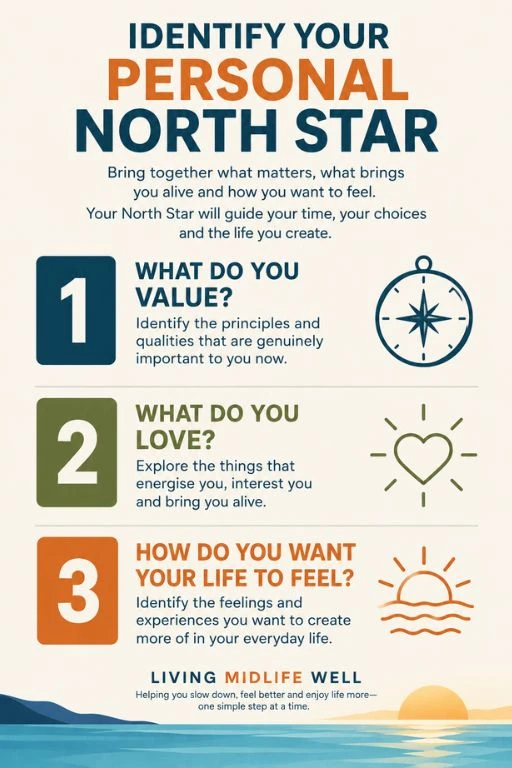
To help you identify what your authentic life purpose is and what is important to you, I am going to invite you to reflect on three key questions:
-
What Do You Value?
-
What Do You Love?
-
How Do You Want Your Life to Feel?
Let’s look at the first of those questions.
What Do You Value?
How to Identify Your Core Values in Midlife
There are a lot of different systems available to help you identify your values and some of them are a whole programme in themselves. If you want to go into more depth with this then you can. What I am going to give you here is enough to get you started with identifying what is truly important to you. What we want to clarify are the values that are truly core to you at this point in your life, rather than values you have taken on from others, or ones that were your focus when you were younger. Sometimes there is a bit of a split between what we value and how we are actually behaving. Let go of any judgemental awareness about this for now, and just focus on what your ideal is. In other words, what you aspire to.
Here are some questions to help you uncover what your core values are:
What are 5 characteristics you exhibit when you think you are at your best?
What are 5 characteristics you would like to be known for?
What are 5 filters that you use when making big or hard decisions?
If you need some ideas to get you started here is a list of thirty-six common values.
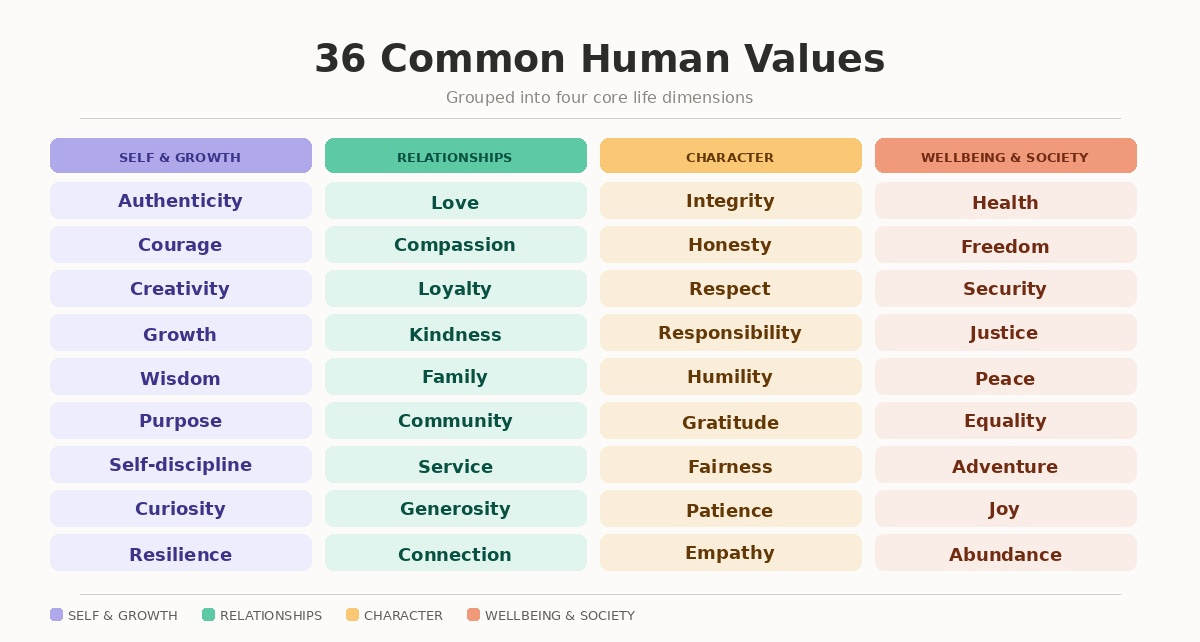
I recommend taking a few days or even weeks to think about this. Let the questions sit with you and prompt you to notice things that you may not have noticed before. Once you have your list of fifteen things, evaluate what you have written down and edit or condense it into your top five values. To help you do this you may want to think about:
What makes this value important to me?
Is this a “North Star” value for me - something that I want as a key guiding factor in my life now?
What Do You Love?
How to Discover What You Love and What Brings You Alive
The next question is, “What do you love?” We want to enjoy life, but even more than that, what you love can give you an important clue about the contribution you want to make and the way you want to spend your life. This may sound radical, and if you want to read more about what my reasoning is for this, then check out this article. For this process, we are going to take it as given that what lights you up is the core essence of who you are, and that is the essence you are here to experience. That is your purpose. That is how you bring light and joy into the world. It is the healthiest and highest version of you. Let’s identify that next by using the following questions:
-
What would you do with your time if you had abundant savings in the bank to live on for the rest of your life? i.e. you didn’t need to earn an income
-
What did you love doing before you started worrying about whether it was useful, sensible or productive?
-
What energises you when you experience it?
-
What do you most like reading about, thinking about, talking about, and dreaming about?
You may have identified more than one thing for this. If you have, then try ranking them in order with one being what you love the most.
Now that you have identified what you value most and what you enjoy most which is also your purpose, the third thing is how do you want to feel.
How Do You Want Your Life to Feel?
This is not a commonly asked question, but I think it is a key one. Most life planning systems focus on the things that you want to create in your life, for example, trips you want to go on, people you want to connect with, cars you want to own, work you want to do, homes you want to live in etc. I approach life planning differently. I focus on how you want to feel in your life. The reason for this is because it is a more powerful energy and allows for greater possibility. When you focus on getting a particular physical thing as your goal, let’s say it is to retire by age 55 and move to Greece, then it concentrates your focus and energy on just one outcome, and satisfaction only comes when you obtain that one outcome. However, while you think you want to retire early and live somewhere new, what you really want is the feelings that go with that. For this example it might be the feelings of freedom, adventure, spaciousness, vitality or discovery, which you think that will give you. In linking those feelings to that one outcome, you limit yourself in terms of how you can feel that, and create a situation where if you do not obtain that outcome, then you may not experience those feelings at all. This can shift you into an “I’ll be happy when . . .” way of thinking, where your happiness is conditional on you acquiring certain things.
This is why I focus on the feelings themselves. It is the feelings that you really want and when you make those your focus, then you realise that you can feel them in all sorts of ways and you can feel them in some way now. They don’t have to be linked to just one goal, or be conditional on having one particular experience.
While specific goals do create focus and make it more likely that we will obtain the thing we have decided to create, when that is one specific physical thing that is dependent on other external factors, then we have less control over experiencing it. Plus, it is out there in the future. We don’t have it yet, and there is a part of our mind that holds that understanding and can create the split energy of we want it, but we don’t have it.
While we can't simply choose how we feel, we can influence the conditions that make certain feelings more likely. For instance, we can deliberately focus on thoughts that stimulate those feelings, and chose ways of looking at things that direct the feeling response we have about them. We can stimulate feelings in all sorts of ways, and because we can feel what we want now in some way, then the message we send to our mind is that we can experience this, it is part of our life now, and it is safe and familiar. When you find ways to experience these feelings in your everyday life, they stop being something you are waiting for and become part of the life you are actually living. The flow on from this, is that you are far more likely to experience more of those feelings in a variety of ways and that is what you actually want.
I really like how this quote from author Elle Sommer captures this idea:
Living a ridiculously great life doesn’t come from your accomplishments, nice as they are, nor your relationships, however filled with love, nor from how much money you have . . . it comes from the quality of the feelings that you live on a daily basis.
This is the secret sauce to creating an everyday life that you enjoy. It is not so much about doing the big things, but about learning to live your joy in the little things.
To identify how you want your life to feel, imagine yourself moving through your ideal day and notice what feelings you connect with it. Imagine having some of the key things that you desire for yourself or your life and notice what feelings come up for you in connection to that. Here are some guiding questions to help you to do this:
Imagine an ordinary Tuesday in your ideal life.
-
How do you feel when you wake up?
-
How do you feel as you move through your morning?
-
How do you feel about the work or activities you are doing?
-
How do you feel in your relationships?
-
How do you feel in your body?
-
How do you feel at the end of the day?
Don’t worry about whether this life is realistic yet. You’re not creating a plan. You’re identifying how you want your life to feel.
If you find it hard to imagine or visualise, then you can write it down like a story as told from the perspective of you as the main character, or describe it to someone else if you process better through talking.
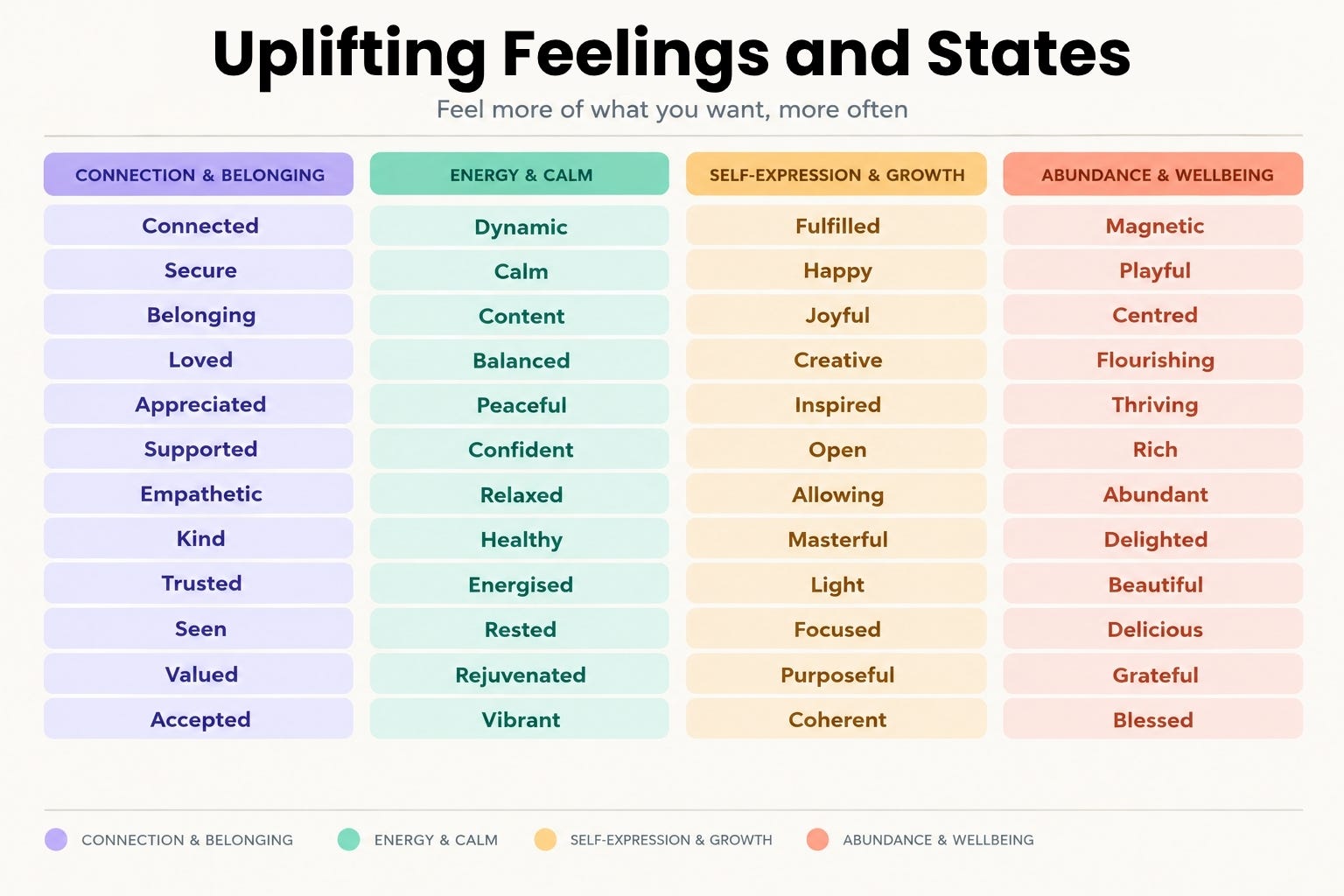
To give you some inspiration here is a list of words to help you identify how you want your life to feel.
Create Your Personal North Star for Midlife
We can now use this information to formulate a clear focus which we can call your North Star. This is your personal guidepost to your highest self and best life. It encompasses the values, purpose and energy you choose to live your life in alignment with. It is like a mini manifesto for how you want to live your life. Now that you have identified your top values, what brings you joy and how you want your life to feel, look for any interconnection or overlap between them. What we want to work this down to is your top 2-3 things in each category. Once you have identified these, you can write them down using the following structure:
My North Star:
I value: [your top 2-3 values]
I love: [the top 2-3 things that stimulate joy for you]
I want my life to feel: [the top 2-3 uplifting feelings or states that you want to feel on a daily basis]
Use Your North Star to Reclaim Your Time
Your North Star isn’t another list of goals to achieve. It’s a filter you can use when making decisions about your time. When you’re deciding whether to take something on, ask:
Does this align with what I value?
Does this make space for what I enjoy?
Does this contribute to how I want my life to feel?
You can start doing this now in terms of your life in general and think about:
What do you want to spend more of your time engaged in?
What do you want to spend less of your time engaged in?
These questions give you something to come back to when life starts filling up again. You might have a request from somebody, an invitation, a new commitment, or something you think you should be doing, and instead of immediately asking, “Can I fit this in?”, you can pause and ask whether it fits with your North Star.
Create a Life That is Powerfully Yours
Reclaiming your time in midlife starts with getting clear about what you want to invest your time in. It’s easy to find yourself living a life you have inherited without stopping to ask whether it is still the life you want. A life that was shaped by expectations, responsibilities, habits and decisions that made sense at the time, but may now no longer fit with who you want to be. Clarifying what you value, what brings you alive and how you want your life to feel, and creating your personal North Star, gives you a clearer sense of what deserves your time and what doesn’t. When you have that clarity, boundaries become easier. Saying yes or no becomes less about whether something is objectively important and more about whether it deserves a place in your life. Reclaiming your time in this way is actually about reclaiming your life and make it powerfully yours.
Where You Can Start: Choose Just One Feeling Each Day
If this whole process feels like too much at this point, then you can easily do one part of it on a daily basis. Each morning, just choose one or two feelings you want to invite into your day. This is also one of the practices in the LMW Morning Reset.
You don’t have to redesign your whole life today. You can start by noticing how you want to feel and looking ways to create more of that feeling in your daily life.
Maybe today you want to feel spacious.
Maybe you want to feel connected.
Maybe you want to feel energised.
Maybe you want to feel peaceful.
Just choose one.
And then look for one small opportunity to create a little more of that feeling today.
Are You Ready For More?
If this has inspired you and you want to do more of this type of intentional life planning then you can join the inaugural group for my new
LMW Reinvent Your Life 21 Day Programme
Reclaim your time, restore your energy and create the blueprint for your best next chapter.
As part of this 21 day programme I will guide you through the process I have outlined in this article and we will go into more detail with a workbook, video tutorials and live Q n A sessions. The Reinvent Your Life 21 Day Programme will merge together this process, the LMW Morning Reset and the Life Priority Method to form a simple but effective way that you can plan and structure your daily life to boost your energy levels, and create time for yourself and the things that really matter to you.
My aim has been to create an effective daily planning system for people in their forties and fifties which gives them increased time and energy without being overtaxing if you are already feeling overwhelmed and exhausted. What I want to give you is support to help you make some simple shifts that will make your life easier and more enjoyable
The first programme will start on 1 October 2026
FREE to join this time only
Click here to learn more.
Aroha nui, much love
Janine
Do you know someone who could really do with knowing this information? Feel free to share this post with them.
Frequently Asked Questions About Reclaiming Your Time in Midlife
What does it mean to reclaim your time in midlife?
Reclaiming your time in midlife means becoming intentional about where you spend your limited time and energy rather than trying to fit everything into your life. It starts with deciding what matters to you, what you love and how you want your life to feel. Once you have that clarity, you can make better decisions about what deserves your time, what can be reduced or removed, and where you want to set boundaries.
Why is time management different in midlife?
Time management can feel different in midlife because responsibilities may increase while energy, stamina and capacity can change. Work, family, relationships, caring responsibilities and everyday life can leave little space for yourself. Rather than simply becoming more productive, midlife can be an opportunity to step back and decide what is genuinely important and what you want your time to be used for.
How do I decide what deserves my time?
Start by asking yourself three questions: What do I value? What do I love? How do I want my life to feel? Your answers can help you identify the people, activities, experiences and priorities that are most meaningful to you. You can then use this clarity as a filter when deciding what to say yes to, what to say no to and what you are willing to let go of.
How can I stop spending so much time on things that don't matter?
Rather than immediately trying to manage your time more efficiently, first identify what genuinely matters to you. Look at your current responsibilities and activities and ask whether they align with your values, what you love and the way you want your life to feel. This can help you identify things that have become habits, expectations or unnecessary "shoulds" that no longer deserve as much of your time.
How do I find my values in midlife?
You can begin by thinking about the qualities that matter most to you. Ask yourself what characteristics you show when you are at your best, what you would like to be known for and what principles guide you when making important decisions. From there, look for the values that repeatedly appear and narrow them down to the few that feel like genuine guiding principles for your life now.
How do I discover what I really love?
Think about what naturally interests and energises you. Ask yourself what you would spend your time doing if you didn't need to earn an income, what experiences energise you, and what you most enjoy reading about, thinking about, talking about and dreaming about. What you love can provide important clues about what brings you alive and the kind of life you want to create.
Why should I think about how I want my life to feel?
Thinking about how you want your life to feel can help you move beyond specific goals and possessions to identify the experience you are really seeking. For example, a particular goal might represent feelings of freedom, happiness, adventure or fulfilment. When you identify those underlying feelings, you can look for different ways to experience more of them in your everyday life rather than making your happiness dependent on achieving one particular outcome.
What is a North Star for your life?
A personal North Star is a simple guide for how you want to live. It brings together your core values, what brings you alive and the feelings you want to experience more often. Rather than being another goal to achieve, your North Star can act as a filter for decisions about your time, priorities, relationships and commitments.
How can knowing my values make it easier to set boundaries?
Clarity makes boundaries easier. When you know what matters to you, deciding whether to say yes or no becomes less about whether something is objectively important and more about whether it deserves a place in your life. Your values give you a clearer reason for protecting your time and energy without needing to justify every decision to yourself or other people.
What if I don't know what I want my life to look like in midlife?
You don't need to have your whole future worked out. Start by noticing what matters to you, what brings you alive and how you want your everyday life to feel. Your North Star is not a detailed five-year plan. It is a direction that can help you make more intentional choices as your life continues to evolve.
How can I start reclaiming my time if this process feels overwhelming?
Start with just one thing. At the beginning of each day, choose one or two feelings you would like to experience that day and let them guide some of your choices. You don't have to redesign your whole life at once. Small moments of intentionality can begin to shift how you experience and use your time.