Have you ever seen someone post online that they’re struggling and just not known what to say? Or maybe someone close to you has been going through something painful and you’ve found yourself lost for words, worried about saying the wrong thing, or just hoping someone else would step in? You’re not alone. Most of us were never taught how to sit with other people’s pain or our own.
I recently read a social media post that said:
"When someone says they’re struggling and people keep scrolling . . ."
and it got me thinking about the ways in which we respond to people who are hurting or struggling.
I think that in a few instances people keep scrolling because they don’t care, but more often I think they don’t respond because they don’t know how. People either don’t know what to say or are afraid of saying the wrong thing. They worry about sounding fake if they just express a common platitude like “I’m sorry”, or fear misreading what the other person is experiencing or needing. Sometimes they don’t say anything because they don’t know the answer to the other person’s problem and think that in order to help they have to provide a solution.
The issue is not just that we don’t know how to comfort other people who are hurting or struggling. The underlying matter is that in Western society we are not taught how to sit with pain in general. We are taught to fix it if we can or otherwise suppress or avoid it in a multitude of ways. Pain is uncomfortable and we live in a society that craves comfort. Comfort is connected with strength, success and wealth, discomfort with weakness, failure and poverty.
What if we could develop a different perspective of pain that would empower us to respond to it in ourselves and others in a more beneficial way? Pain and discomfort are not just something experienced by people who are weak or poor. Everyone experiences them in some form at various times. Some people may have more resources to hide behind, but it will still be present there somewhere.
Developing Emotional Literacy
To be able to sit with other people’s pain we first have to be able to sit with our own. The first step in doing that is to understand that all emotions are simply a way of communicating information. I believe that all emotions are valid and serve us in some way. Therefore, I think that it is more helpful to describe emotions as comfortable or uncomfortable, or pleasant or unpleasant, rather than judge them as good or bad, or positive or negative. Unpleasant emotions tell us that our needs are not being met, that we are unsafe or that we have patterns of thought and belief that are causing us to feel that something is wrong.
We become afraid of uncomfortable emotions. They can seem big and overwhelming and the way they are expressed can be hurtful, but that is because we have not all been taught how to process them effectively. People who have experienced trauma may also shut down to both their own and others’ emotions which can be seen as a protective freeze response. Other people may respond to emotional stress with a fight (frustration/anger) or flight (avoidance) response. When we understand that unpleasant emotions are simply signals asking us to pay attention to something, then managing them in ourselves and others becomes less scary. Less fear means less stress and when we feel less stressed, we have more mental and nervous system capacity to respond.
(If you want to learn more about how to effectively feel and process your emotions then I go into that in more detail in Step 6 in my book 10 Steps to Happiness.)
Developing your own emotional intelligence and learning to process your own emotions in healthy ways is the first step in being able to comfort people who are hurting or struggling. The next step is the skill aspect of what to do and what not to do.
I am going to start with the what not to do first.
1. Avoid Saying “I’m Sorry”
This one may come as a surprise because it is a very common response to say something like “I was sorry to hear that . . .” or “I’m sorry that happened to you” to someone who has experienced something undesirable or painful. The reason I advise you to avoid saying it, is because it puts a sense of responsibility and heaviness on you, and it really doesn’t offer anything to the other person. It is an empty statement and closes rather than opens conversation. It is an attempt to express sympathy, but there are more effective ways to do that
2. Avoid Trying to Fix the Problem
For example, saying something like, “You should try doing this…”
Offering unsolicited advice and trying to “fix” someone so that they feel better is one of the least helpful things you can do, because it overrides what they are thinking and feeling. Fixing, solving and rescuing someone indicates to them that they are not capable of working through this themselves. It links back to the perception that pain and discomfort are connected to weakness, failure and poverty, which isn’t true, and is not an empowering perspective to come from.
3. Avoid Talking About Your Own Experience
Many people try to show someone that they can relate to what they are saying by sharing their own similar experience. However, when you do this, it shifts the focus onto you. It also creates more information for the other person to process and this can add to their overload when they are already in a state of stress. This is especially impactful for people who are highly sensitive or have an ADHD or autistic neurotype. Simply listen, and reflect and ask questions about their experience first. Once the distressed person has processed their thoughts and emotions and are feeling more settled, if you have a personal story to share that may give them a helpful example then you could ask, “Is it okay if I share something that I think may be helpful?” If they say yes, then share, but ask first.
4. Avoid Forcing the Person to Cheer Up
Trying to get someone who is sad to smile or someone who is hurting to cheer up is again overriding what they are actually thinking and feeling, and indicates that there is something wrong with what they are feeling. This often links back to people’s own discomfort with unpleasant emotions and trying to avoid dealing with them.
5. Avoid Getting the Person to “Look on the Bright Side”
This is another common thing people do which is linked to trying to cheer people up, but deserves to be looked at separately. It includes phrases like:
“At least you didn’t . . . “
“[he’s] in a better place now”
“It could have been worse . . .”
“[name] has it much harder than you”
“Everything happens for a reason.”
“Try and stay positive”
When you try and get someone to see the positive in their pain when they are in the midst of it, it minimizes and dismisses what they are currently experiencing. This goes double when you compare their experience and response to someone else. All of your feelings are valid for you regardless of what anyone else experiences, and feelings need to be felt to be effectively processed. The best way to comfort someone else is to acknowledge and validate their current experience and emotions and allow them to be expressed in ways that are safe.
6. Avoid Pointing Out Where They Went Wrong
Everyone makes mistakes or bad choices in life, and pointing them out doesn’t help. The person who is struggling is probably already painfully aware of any mistakes they made.
That is my list of key things to avoid. Now here is the empowering list of effective ways to support someone who is hurting or struggling:
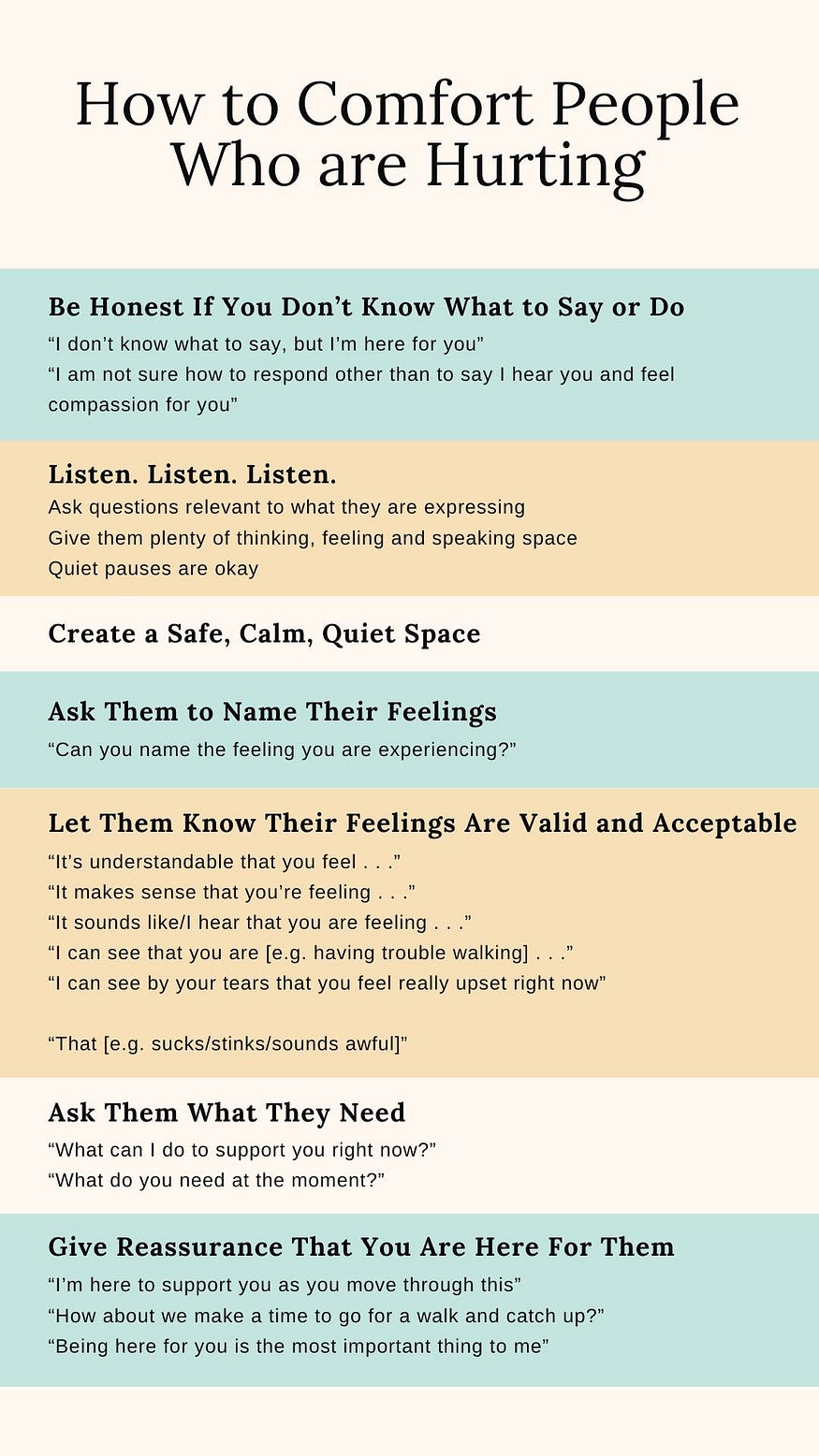
1. Be Honest If You Don’t Know What to Say or Do
You don’t have to have all the answers. You don’t need to know how to solve their problem to help someone. You don’t have to be a wise guru and say all the right things. If you don’t know what to say or do, just be honest and tell the person that. Simply say something like:
“I don’t know what to say, but I’m here for you”
“I am not sure how to respond other than to say I hear you and feel compassion for you”
Being vulnerable about what you are experiencing creates a safe space for them to express what they are experiencing rather than having to put on a “brave face” or mask what is truly going on.
2. Listen. Listen. Listen.
You may think that all you can do is listen, but often that is the key thing that the other person needs. Remember, what people need most is to be seen and heard. Listening while someone talks through their problem is validating and productive. Listen with all your senses, notice what they say, their body language, how they respond to things around them and non-verbal sounds like sighing. Ask questions related to what they are talking about. Also, be accepting of silence. Quiet pauses are okay. Sometimes people who are stressed need extra time to process their thoughts and emotions and put them into words. Give them plenty of thinking, feeling and speaking space, and space to simply sit in silence with you if that is what they need.
(If you want to learn some helpful conversation phrases that you can use to actively listen to someone, then I give a list of these in my ebook guide, Stop Absorbing Other People’s Problems)
3. Create a Safe, Calm, Quiet Space
Be mindful of the environment you are in. If it is too loud, busy or lacks privacy then maybe suggest going for a walk or meeting up at another time for a quiet coffee or drink. Being in a calm place, particularly in nature, will help the person’s nervous system to settle enabling them to be less driven by emotion and more able to think clearly.
4. Ask Them to Name Their Feelings
Say something like: “Can you name the feeling you are experiencing?”
Asking someone to name their feeling/s does two things: it clarifies for you what they are feeling, and it helps them to switch from the emotional to the logical language processing part of their brain. When you experience stress, your amygdala activates and takes over. You can think of this as your primal emotional brain. The pre-frontal cortex is the evolved part of your brain that allows you to think logically and rationally. When your amygdala is switched on, your pre-frontal cortex goes offline, and when your pre-frontal cortex is engaged, your amygdala quiets. Labelling your emotions with a precise word, engages the logical, rational part of your brain and quiets your primal emotional brain. Asking someone to name their emotions with a label of one or two words can help to calm their emotions quickly without overriding or suppressing them.
5. Let Them Know Their Feelings Are Valid and Acceptable
You can say things like:
“It’s understandable that you feel . . .”
“It makes sense that you’re feeling . . .”
“It sounds like/I hear that you are feeling . . .”
“I can see that you are [e.g. having trouble walking] . . .”
“I can see by your tears that you feel really upset right now”
You can validate what the other person is feeling by reflecting back to them what you hear them saying or what you are observing, or by letting them know that it is okay or understandable to be thinking or feeling the way they are.
Validating someone’s feelings can also include affirming that what they are experiencing is hard, painful or frustrating. Acknowledging that what they are experiencing is awful creates a space where they can relax and not have to act like everything is okay when it is not. A lot of bad things can’t be fixed, and sometimes the most comforting thing you can do is simply sitting with someone and being honest about how horrible their situation is. Not in a “pity-party” kind of way, but in a way that allows for the relief of being able to tell it like it is.
For example saying “That [e.g. sucks/stinks/sounds awful]”
6. Ask Them What They Need
You can use questions like:
“What can I do to support you right now?”
“What do you need at the moment?”
People process things in different ways and at different times so even if you know someone well, it is always a good idea to ask them what they need in that moment rather than assuming what would be good for them. It is best to be specific rather than saying something general like “let me know if you need anything.” Some people find it challenging to ask for assistance, so it can be helpful to make your request into just one step and ask, “what is one thing you would like me to do for you right now?” This can also be helpful if the person is feeling very overwhelmed and having trouble planning. Remember that when we are in distress (stress) our emotional brain takes over and we can find it hard to access our rational, logical pre-frontal cortex. If someone is really struggling to think rationally, they may not be able to process what they need. In this case you could offer specific, tangible actions which may be helpful to them.
It is also beneficial to ask for what they need at the moment or right now because it requires less thinking to identify what we need currently as opposed to thinking longer term. It also guides the other person to focus on the present moment rather than spiraling into the past or future which they have no control over.
7. Give Reassurance That You Are Here For Them
Even people who like to have personal space to process, desire forms of support. You can reassure someone that you are here for them with phrases like:
“I’m here to support you as you move through this”
“How about we make a time to go for a walk and catch up?”
“Being here for you is the most important thing to me right now”
It is also advisable to balance caring for others with caring for yourself. Even if the other person is emotionally fragile, it is okay for you to create boundaries for your own self-care, because in order to be able to effectively support others you need to be resourced yourself.
Presence, Not Perfection, Is What Hurting People Need Most
In order to comfort someone who is hurting or struggling you don’t need to have all the answers or be able to impart words of wisdom. You don’t even need to do something to make them feel better because many times you can’t. What they are going through is horrible and the best thing you can do is simply be there for them as they move through it. Being present, actively listening, and accepting whatever they are thinking and feeling without judgement is the most effective way to create a healing space for them. This article contains a long list of tips, be aware of the things to avoid and focus on the things to do. When you put your attention on doing what is helpful, you will naturally avoid doing many of the things that aren’t.
Quick Reference Summary of Things You Can Say to A Friend Who is Hurting
You can save this image to your phone as a quick reference guide.
Press enter or click to view image in full size