
How to Deal with Difficult People in Midlife
Are you dealing with a difficult person in your life? It may be a co-worker who is always getting in your face, a mother-in-law who loves to give you her advice, a rude neighbour, an unreasonable boss, or even a grumpy or defiant child or teenager. Midlife often brings greater self-awareness, but this time of transition can also bring more challenging relationships through things like changing family structures, marital separation, children becoming adults, and hormonal shifts reducing tolerance levels. Dealing with difficult people in midlife can lead to feelings of anxiety, stress, anger, frustration and of being trapped in a situation you do not want to be in. It can also be a big drain on your energy. Learning how to deal with difficult people isn't about changing their behaviour; it's about strengthening your own emotional resilience, setting healthy boundaries, and responding with confidence instead of reacting from stress or frustration. In this guide, you'll discover five practical strategies to help you manage difficult people in midlife, protect your energy, communicate more effectively, and create healthier, more peaceful relationships while continuing your own journey of personal growth.
(if your would prefer to listen to the podcast version of this article you can listen on YouTube here)

Two Mindset Shifts Before You Deal with Difficult People
Before we get into talking about specific strategies, there are two key underlying principles to any successful interpersonal interactions:
-
Focus on What You Can Control: You can only control your own thoughts, feelings and behaviour, and you are responsible for your own thoughts, feelings and behaviour.
-
Remember That Everyone Can Be Difficult Sometimes (yes, even “really nice” people)
Why You Can't Change Other People's Behaviour
As soon as you start trying to control other people’s behaviour, then you are in trouble. It can be done through manipulation or force, but that is not really ethical, usually not overly effective, and it takes a lot of energy on your part to maintain the control. Most people don’t like being controlled or told what to do and will rebel against it in some way, or only do what they are told when someone else is putting pressure on them. Even asking a question like “why are they doing this to me?” is putting your focus and energy on something you cannot answer or control.
“Control the knobs on your side of the wall.”
- Pastor Daniel Fusco
You may think that it is the other person who is the problem and it is them that needs to change, but you may be surprised at how much effect it can have when you focus on your own thoughts, feeling and behaviour - the things you can control.
Compassion Doesn't Mean Accepting Poor Behaviour
As we reflect on our own behaviour, we can also note that sometimes we can be difficult to deal with too, usually without meaning to be. Ask any happily married couple and they will be able to name at least one habit or personality trait of their beloved that annoys or frustrates them. Our difficult traits don’t necessarily make us difficult people. Often, the that triggers you about someone else is more to do with your likes, dislikes and wiring than it is about them. In the same way, someone exhibiting difficult behaviour may not be directing it personally at you - they could just be feeling stressed or frustrated about something else, or be tired, or feeling unwell. We all get grumpy and snap at people sometimes. Be open to trying to see why they may be behaving this way, and if they are being difficult because they are going through something demanding, then try and extend compassion to them while maintaining boundaries to protect yourself mentally, emotionally and physically. It is important to note that a person’s ‘why’ is a reason, not an excuse. You can understand why a person is doing something, but that does not mean that what they are doing is okay. The main purpose of being understanding is to help you to manage your response, rather than being drawn into an emotional reaction to someone else’s issues.
Look at the other person through a lens of compassion and approach the situation as a puzzle to be solved rather than a threat to defend yourself against. Remember that everyone is doing the best they can from where they are and that not everything is about you. What is this person really trying to gain? What are they trying to avoid? Chances are, if a person is acting unreasonably, they are likely feeling some sort of vulnerability or fear. Consider what may be going on for them, but remember that we don’t know what another person is really thinking and feeling unless they tell us. If you feel able to, then maybe you could ask them about what is going on for them, and what they are intending or wanting for themselves.
How Your Own Reactions Shape Difficult Relationships
Reflecting on our own behaviour also means being honest and fair about the role that we are playing in our interactions with people. Are you being difficult in some way? Are you asking more of them than they are capable of? Do you have expectations that you have not clearly stated to them? Are you tired or stressed? Are you responding in an abrupt or angry way and escalating things? Are you taking everything personally and beating yourself up for things that are not your responsibility? It can be uncomfortable to take responsibility for your own behaviour in this way, but it is necessary if you want to create meaningful and lasting change.
With this foundational understanding established, that you need to come from a place of focusing on the knobs on your side of the wall and extend curiosity and compassion to the other person, let me give you five specific strategies for dealing with difficult people in midlife.
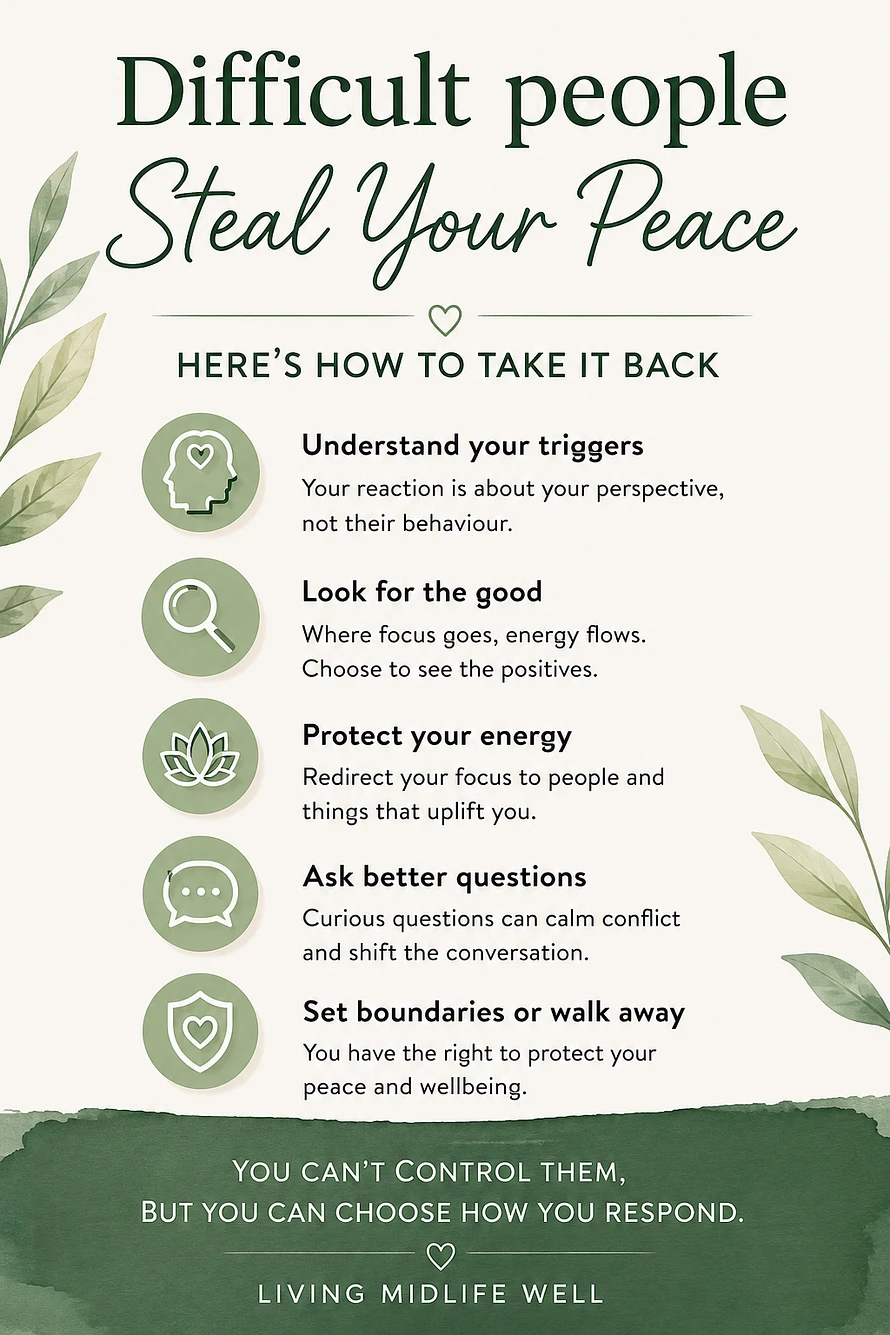
5 Practical Strategies for Dealing with Difficult People in Midlife
Strategy 1: Identify Your Emotional Triggers
“The negative emotion you feel is not about what they’re doing,
it’s about your perspective of what they are doing.”
– Abraham Hicks
Why Certain People Trigger Strong Emotions
What we see or perceive in others is a projection of our own beliefs, judgements, values and experiences. In Neuro Linguistic Programming (NLP) this is referred to as “perception is projection”. If you find that someone else’s behaviour ‘pushes your buttons’ and stimulates a strong emotional response in you, then it is likely that their behavior is somehow a projection of attributes you possess which you wish you didn’t, or they represent something you fear, or they represent something you will not allow yourself to be or have.
This is not a judgment of you; it is a gift.
It is information that can help you become free.
When you are in a place of blame and seeing things outside of you as the source of your negative experience, then you are largely powerless because it is very difficult to change other people and all the circumstances of our lives. When you accept that how you feel is the result of how you are thinking about a certain person or condition (your perspective), then you empower yourself, because you have full control over what you choose to think and the meaning you choose to give something.
Questions to Help You Understand Your Triggers
These reflection questions may help you to clarify any triggers that are operating subconsciously for you with regards to someone you find challenging:
What emotion is being triggered in me?
In what ways does this person represent something I am afraid of?
In what ways does this person represent something I want?
What does my response to this person show me about parts of myself that are asking to be accepted and loved by me?
Ask these questions with an attitude of curiosity and pondering and let go of any judgement towards yourself. Also, ask them and allow space for the answers to come. It is not likely that insight will come straight away. Sometimes when I ask these types of enquiry questions in a state of meditation, I do receive a direct intuitive response. More often however, the answer will come later in a more indirect way. Someone may say something to me that clicks as the answer, or I may be drawn to a particular article, video or book that gives me information that helps me. At times I will have an experience that enables me to understand something more clearly.
Strategy 2: Look for the Positive Instead of the Problem
Why Your Focus Changes Your Experience
This strategy involves actively looking for positive aspects about the difficult person that you can begin to appreciate. I understand that it may seem very challenging to find positive things about a person who you find vexing and may strongly dislike. It may also sound a bit like a “just be nice” platitude, but it is not about avoiding the issues. This isn’t about pretending everything is okay. It’s about reclaiming your focus. This strategy taps into your power to change your world by shifting your focus. Whatever you choose to focus on is what will become dominant in your mind and what the reticular activating system (your incoming information filter) in your brain will give you more evidence of. If you continue to turn your focus to what you do like, then that will begin to grow. As Tony Robbins says, “where focus goes, energy flows.” This will take time and practice, especially if you have been focusing in on what you don’t like for a while and that has a lot of momentum in terms of what you have been thinking and talking about. However, maybe you could recognize that there are qualities in the person that are worth knowing. Or, you could start to make a list of things you do like even just a little about them. As you focus on trying to find positive aspects about the other person, you will begin to notice them more readily.
The Science Behind Emotional Contagion
There is another thing that will likely start happening. Focusing on seeing the positive qualities of the other person, will draw out more of those aspects from the other person. This is similar to the parenting and teaching concept of praising positive behavior in children to encourage more of it. There is also an energy aspect to this. Your brain and even more so your heart emits an electromagnetic energy field that is largely determined by your thoughts and feelings. The tone of your energy field will activate similar energy tones in other people in the same way that a tuning fork can entrain the tone of other tuning forks. Tuning forks have set natural frequency and when you set it ringing, then sound waves from a struck fork transfer physical energy through the air, vibrating any nearby forks that have the same frequency and pitch. This is called sympathetic resonance and it works in humans as well.
For humans, sympathetic resonance is when is when one person unconsciously mirrors or internalises the emotions, behaviours or physiological rhythms of another person. This can happen through three pathways: mirror neurons, physiological entrainment and emotional contagion. Mirror neurons are specialised brain cells which provide the neural foundation for observational learning. When babies, children or adults watch someone perform a skill, the mirroring mechanism helps the brain map out how to copy the movement. When you observe emotions in someone else, mirror neurons activate the same brain regions in you that correspond to those emotions, and allow you to physically "feel" what someone else is experiencing. This mechanism helps us connect socially and understand non-verbal cues. It is the reason we tend to yawn when we see someone else yawn and smile when someone else smiles. Physiological Entrainment is the natural tendency for two or more rhythmic systems (such as heart rates, breathing patterns, or brainwaves) to synchronize when people are in close proximity. Emotional Contagion refers to the subconscious transfer of moods. For example, the sympathetic nervous system can activate in response to someone else’s stress, causing your own heart rate to subtly increase in sympathy.
The impact of this, is that while we can only directly control our own thoughts, feelings, behaviour and focus, in doing so we can intentionally set the tone which others around us may then mirror or become entrained to.
Strategy 3: Redirect Your Focus and Protect Your Energy
How to Stop Giving Difficult People Your Mental Energy
This is similar to the first strategy and again focuses on reclaiming your focus, but instead of looking for positives in the difficult person, which may feel too challenging, you just look for general positive things in your life, or create things to look forward to. For example, focus on what you are grateful for, do more of what you enjoy, spend time with people who uplift you, watch feel good movies, listen to comedy, or watch funny animal videos. As much as you can, take your focus off the person you are finding difficult and focus on anything else that feels like joy, fun, excitement, optimism, freedom, allowing, love, peace and appreciation. This is based on the same principle of “where focus goes, energy flows” and the aim is to diminish the amount of energy you are giving to the difficult person.
Strategy 4: Deflect Difficult Behaviour Without Absorbing It
Questions That Calm Conflict Instead of Escalating It
One of the most powerful things you can do in terms of building better relationships is learning to ask effective questions. In this case, asking questions that require the difficult person to think about what they are saying or doing can have two effects. It makes you less of a neutral, agreeable target, and it can prompt people to come up with their own solutions and solve their own problems without drawing you into their drama. Asking questions like the ones below with a curious enquiring tone gently challenges the other person while allowing you to remain neutral. Their response may be to leave you alone because you now require too much energy to engage with, or it may facilitate growth or a solution for them which decreases their difficult behaviour. Ask these questions in a “grey rock” manner that is strong and emotionally neutral. Difficult people often feed on your emotional responses. Having a list of questions like this to ask can help you feel more confident and engage in a calm way.
These questions are not an ordered list to work through. They are options - like a toolkit. Pick one or two to learn and have ready that will work well for the type of interactions that you are having with the challenging person. For example, if you have someone in your life that tends to be negative and complain a lot and you find that draining then you could use a question like, “What would a positive outcome look like to you?” to redirect their line of thought.
Please note, the way the questions are worded is purposeful and specific to direct someone’s thinking in a certain way. At first it may feel a quite scripted using these questions, but with practice it will start to feel more normal and comfortable.
10 Questions to Redirect Difficult Conversations
Who else could you ask for information about this?
What would a positive outcome look like to you?
What would be one thing you could do to improve this?
What’s important to you about this?
What other options have you explored?
What could be a good next step to solving this problem?
What could be a good thing about this?
This isn’t a problem for me, who is it a problem for?
Have you told told [the person they are complaining about or the person who can do something about the problem] how you feel/what you think? (good for stopping gossip)
I’m curious, what did you mean by that? (good response if someone has said something undermining or hurtful)
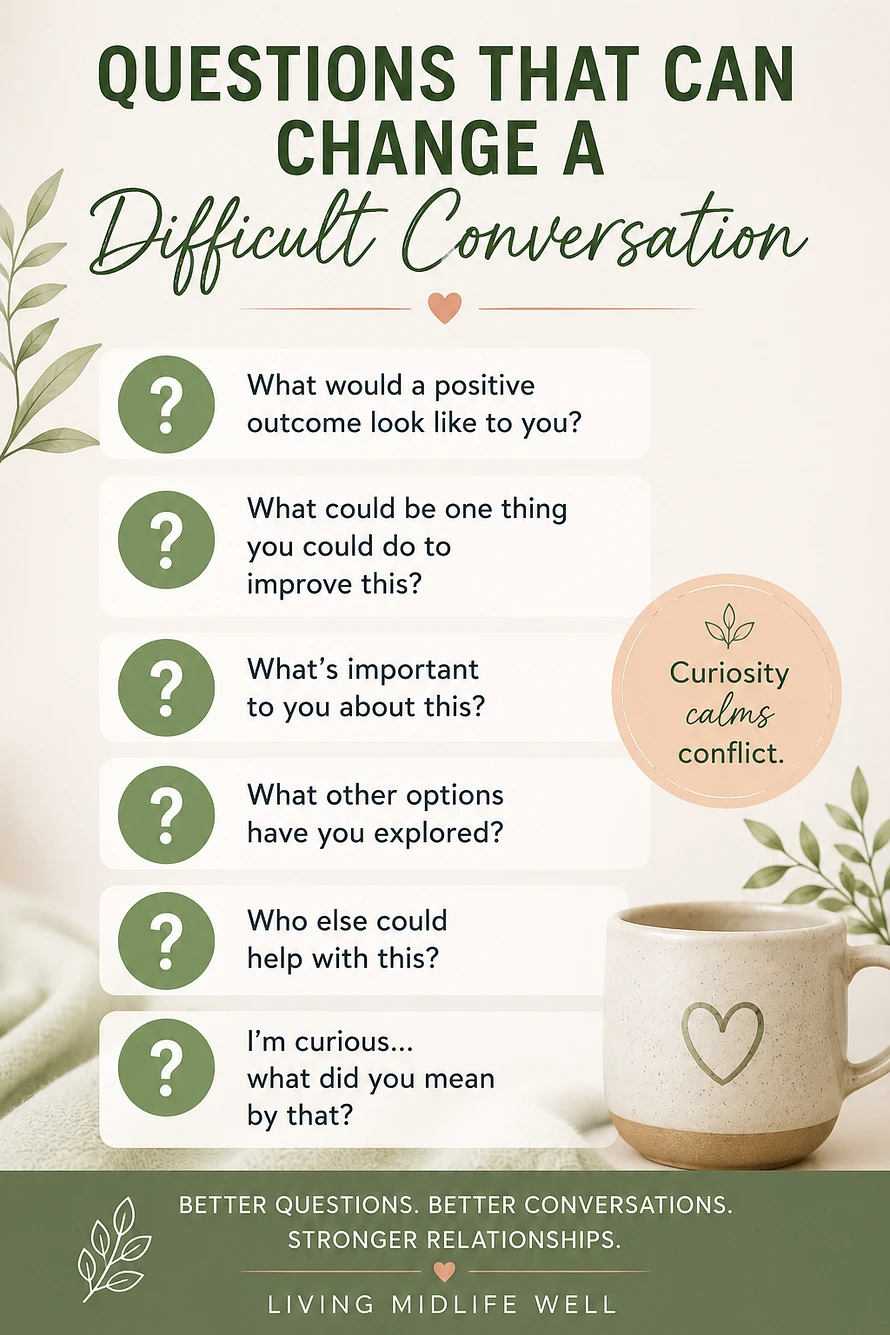
When you use questions like these it looks like you are engaging, but you are not actively taking on the energy of the problem, you are deflecting it back to the person who is carrying it. In this way you avoid making their problem, your problem.
You can also use the Mirror and Affirm process that I describe step by step in my short guide Stop Absorbing Other People’s Problems which you can get from my website. Mirroring using a lower and slower tone of voice can be a good way to de-escalate and calm someone who is yelling or overly agitated. I used it as a strategy for this with teenagers when I was working in student support at a local high school.
Strategy 5: Set Healthy Boundaries or Walk Away
How to Set Healthy Boundaries with Difficult People
You can remove yourself from a situation in two ways; by creating personal boundaries, or by physically removing yourself from a space. Creating a personal boundary is a way of protecting your energy within an environment. Keep the focus on your wellbeing rather than setting boundaries to punish another person. Ask yourself; what do I need to keep myself safe and functioning well within this situation? This may be taking control of the communication channel and organising for interactions to be by written email rather than face to face. It may be restructuring your schedule so that you are not having to operate in the same space as that person or at least reducing the amount of time you have to interact with them. Setting boundaries can also involve having the courage to be honest about what you really need from the other person, and things that you would like changed. Most interpersonal conflict is caused by poor communication - either things are not communicated at all, or there is misunderstanding in the communication. How to communicate to resolve conflict is a big topic that I will write about in more detail in future posts.
When It's Time to Walk Away
If you think that the person is really toxic, or you find that it’s too hard to start thinking nice thoughts about someone who’s right there being a catalyst for your discomfort, then you may need to remove yourself from the situation altogether. This is a valid option if the other strategies are not viable or not working for you. However, I would make it a final option unless there is a safety issue. The reason for that is that this option doesn’t offer you a chance to learn and grow and wherever you go, you will take yourself with you. Human interactions always have two sides and both sides are aways playing a role and bringing things to the interaction. If you continually avoid difficult people and situations, then you will keep encountering them in different forms because you will have patterns of thought, belief and behaviour that are triggered by similar things. Conflict is an opportunity to clear your triggers and develop more effective relationship skills which help you to create better life situations moving forward.
What If You Feel Trapped?
If you want to remove yourself from the situation, but think you can’t, and feel trapped and stuck as a result, then maybe you could soften how you are thinking about the situation. This may decrease your resistance, and create some space for change to occur. One mindset tool that you could use to soften how you are feeling about the situation is to use “what if” questions. These are simply questions that you pose and leave open rather than trying to answer them. The idea is to open your mind to other possibilities rather than a single solution. For example, you could ask:
What if I could leave?
What if I could leave sometime in the future?
What if this situation turned out to be temporary?
Final Thoughts: Becoming More Emotionally Resilient in Midlife
All of the five options listed above are valid ways of responding to a difficult person. Which ones you use depends on where you are at in yourself, how stressed you feel, how empowered you feel, and what you want to create in your life. However, be aware, that wherever you go, there you are. By this I mean that you may seek to move yourself away from a certain situation, but the energy of thoughts, beliefs and emotions going on inside you will go with you, and you will attract the same thing in a different form. This is why we have repeating patterns of experiences in our lives. The only way to effectively change this long-term is to transform your thoughts, beliefs and emotions through loving yourself more.
You can’t control other people’s personalities, choices or behaviour, but you can choose how you respond to them. That is where your greatest power lies. Midlife is an opportunity to stop giving away your energy trying to fix, change or please everyone else and instead focus on becoming more intentional in your own responses. You now have several decades of experience to draw on and can approach challenging relationships with greater wisdom, self-awareness, and emotional maturity. Instead of seeing every difficult interaction as something to endure, you can view it as an invitation to develop healthier boundaries, stronger communication skills, greater compassion, and deeper self-trust.
As you focus on what you can control which is your thoughts, your emotions, your boundaries and your actions, then you’ll likely find that difficult people have less power over your life. Some relationships may improve, some may naturally fall away, and others may simply become easier to navigate because you are no longer reacting in the same way. Personal growth in midlife isn’t about creating a life without difficult people. It’s about becoming the kind of person who can remain grounded, compassionate and confident, even when life brings challenging relationships. The more you strengthen your inner world, the more peace, freedom and fulfilment you’ll create in your outer one.
Just One Thing
My “Just One Thing” action point take-away this week is to pick one or two of the questions to redirect difficult conversations and write them as a reference note on your phone. Start with one or two that you think you could use and start practicing them by using them in day to day conversations that are not overly challenging or emotionally charged for you. Doing this will help you to remember them and feel familiar with them so that it is easier to use them in more difficult conversations when you need to.
There is a lot in this article so if you have any questions then feel free to ask in the comments or message me directly.
Aroha nui, much love
Janine
Frequently Asked Questions About Difficult People in Midlife
How do you deal with difficult people without arguing?
The most effective way to deal with difficult people without arguing is to focus on what you can control rather than trying to change them. Stay calm, avoid reacting emotionally, ask thoughtful questions instead of becoming defensive, and set clear boundaries when needed. Remember that you are responsible for your own thoughts, feelings and behaviour, while the other person is responsible for theirs.
Why do certain people trigger me so much?
People often trigger us because they reflect something within ourselves that is asking for attention. They may represent a fear, an unmet need, a value we hold strongly, or a part of ourselves that we have rejected. Instead of seeing emotional triggers as something to avoid, try viewing them as opportunities for greater self-awareness and personal growth. Understanding your triggers can help you respond more thoughtfully instead of reacting automatically.
How do I stop absorbing other people's emotions?
Begin by recognising that another person's emotions are theirs to manage, not yours. While empathy is a valuable quality, it doesn't require you to carry someone else's emotional burden. Keeping healthy boundaries, redirecting conversations towards solutions, limiting exposure to negativity where possible, and regularly reconnecting with activities that bring you peace and joy can all help protect your emotional wellbeing.
What are healthy boundaries with difficult people?
Healthy boundaries are the limits you set to protect your emotional, mental and physical wellbeing. They might include limiting the time you spend with someone, choosing how and when you communicate, saying no without guilt, or calmly expressing what behaviour you will and won't accept. Boundaries are not about controlling another person—they are about taking responsibility for your own wellbeing.
When should you walk away from a difficult relationship?
Walking away may be the healthiest option if a relationship is consistently abusive, manipulative, unsafe, or continues to damage your wellbeing despite your best efforts to communicate and establish boundaries. However, when safety isn't an issue, difficult relationships can also provide valuable opportunities to develop stronger communication skills, greater emotional resilience and deeper self-awareness before deciding whether the relationship still belongs in your life.
Can difficult people really change?
Yes—but only if they are willing to. Lasting change happens when someone takes responsibility for their own thoughts, emotions and behaviour. You cannot make another person change, no matter how much you care about them. What you can change is how you respond, the boundaries you set, and the amount of emotional energy you invest in the relationship. Ironically, when you change your own responses, the relationship dynamic often changes as well.
Is it normal for relationships to change in midlife?
Absolutely. Midlife is often a season of personal growth, changing priorities and greater self-awareness. As you become more intentional about how you spend your time and energy, some relationships naturally deepen while others become less aligned with the person you are becoming. This can feel uncomfortable at first, but it is often a healthy part of creating a more peaceful, authentic and fulfilling life.