
"All life is an experiment. The more experiments you make the better."
— Ralph Waldo Emerson
Midlife has a way of making us question everything.
Maybe you're in your forties or fifties wondering how life ended up looking so different from what you imagined. Perhaps you've experienced divorce, burnout, illness, redundancy, financial stress, an empty nest, or simply the quiet feeling that you've lost yourself somewhere along the way.
If you've ever caught yourself thinking:
"I've failed."
"It's too late."
"I've wasted my life."
then the beautiful thing is that none of those thoughts have to become your story.
One of the most powerful tools I discovered during my own midlife unravelling was developing what psychologists call a growth mindset. More than any other mindset, it helped me stop seeing myself as broken and start seeing my life as a series of experiments—each one giving me valuable information about who I was becoming.
Today I genuinely think a growth mindset is one of the greatest gifts we can give ourselves in midlife. If I was going to choose one mindset as the most powerful way of approaching life, it would be a growth mindset. My son once said to me that I was like a living embodiment of the growth mindset, I think he was referring to my repeatedly telling him that he can learn anything through practice, but I took it as one of the highest compliments.
People often think a growth mindset is about improving performance at school or work, but I think it becomes even more valuable in midlife. By our forties and fifties, many of us are carrying decades of beliefs about ourselves:
- "I'm just not confident."
- "I've always been anxious."
- "I'm not creative."
- "This is just who I am."
A growth mindset gently challenges these stories.
Instead of deciding,
"I can't"
it asks,
"How could I learn?"
Instead of believing,
"I'm too old."
it asks,
"What's my next experiment?"
What Is a Growth Mindset (and Why Does It Matter in Midlife?)
The growth mindset concept was formed in the early 2000’s by Stanford University professor Carol Dweck. Here is the concept in a nutshell: abilities can be developed through effort, learning, and persistence as opposed to being innate or fixed.
Key points:
-
Challenges help you grow
-
Effort builds ability
-
Mistakes are feedback, not failure
-
You can improve with practice
To put it in my own even smaller nutshell, having a growth mindset is about seeing all experience as experimentation and playing with life.
It is a mindset that encourages creativity, skill development and the valuing of effort rather than just end achievement. However, there is another reason that having a growth mindset is powerful and that is to do with how it influences your nervous system.
To effectively learn, change and form new habits we need to be in a relaxed mode of being. Your nervous system needs to be functioning primarily from the parasympathetic division and your brain needs to be operating largely in an alpha or gamma brainwave state. Having a growth mindset helps to regulate your nervous system and facilitate this calm learning state in three main ways: by reducing threat, providing a clear next step and promoting curiosity.
Why a Growth Mindset Helps You Feel Safe Enough to Change
When you label outcomes as “success” or “failure” then your brain, especially the parts that are connected with ensuring your safety, can connect this with judgement or a risk to your identity or social belonging and therefore interpret failure or success as a threat. Please note, while we often consciously fear failure the most, our body can also interpret success as a threat if it involves significant change to your social or physical environment.
The part of your brain that acts as its emotional and stress-processing centre is called the limbic system. When your limbic system perceives a threat, then it initiates a fight-or-flight response via stress hormones like cortisol.
If your limbic system perceives success or failure as a threat, then it activates the sympathetic division of your autonomic nervous system and puts your body into a stress state. When your body is in an ongoing or highly intense stress state, then it becomes difficult for you to learn. What happens in these situations is that your body switches into emergency mode and down-regulates all the systems that are not linked to immediate survival. This includes the parts of your brain which enable you to be creative, to long term plan and to learn new things. It limits memory activity and tunnels your focus into scanning for threats. In this state, your capacity to set and achieve goals or move forward into positive change and growth is very limited. This is why people who are experiencing a lot of fear or anxiety are often very resistant to change - either good or bad.
Why Treating Midlife Like an Experiment Changes Everything
If you want to be happy and successful then you need to be in a baseline parasympathetic nervous system state most of the time and be able to move easily in and out of activation into stress. Short bursts of stress, as opposed to ongoing chronic stress, can heighten concentration and physical ability in the short term, and that can be helpful. Having a growth mindset can help to regulate your nervous system in this way because when you reframe experience as experimentation, and success and failure as learning data, then the message that you send to your nervous system is:
“I am safe to try, safe to learn, and safe to continue.”
Although we can subconsciously fear success, fear of failure is the threat people are most aware of. Re-framing your thinking and choosing to believe that failure is simply one learning outcome of a life experiment and an opportunity for new ideas and growth, has the result that making mistakes and getting things wrong become less of a threat.
When nothing is labelled as failure:
-
your nervous system doesn’t brace for danger
-
there is less cortisol and stress activation in your body
-
you stay in a more regulated, responsive state
Safety Comes From Having A Clear Path
Your nervous system doesn’t need you to succeed.
It needs you to feel safe enough to take the next step.
Another thing that signals threat to your nervous system is the unknown. The nervous system likes certainty. Certainty is familiar and what is familiar feels safe because you know how to navigate it. When you see failure as an end, then it can create anxiety and fear about what comes next. Seeing mistakes, errors and failures as simply part of a learning continuum of finding out information, removes that element of uncertainty. Whether something succeeds or fails you will receive information from the experience that will inform and guide your next step. Interpreting things this way helps you to feel a sense of control and reduces anxiety and overwhelm concerning what to do next.
Curiosity Is the Superpower of Personal Growth
A growth mindset shifts the brain from emotional reactivity into cognitive curiosity. When you are operating from your limbic brain in a stress state your thinking is very rigid. It is also possible to have a fixed mindset which is the opposite of a growth mindset. A fixed mindset believes that intelligence and ability are innate and cannot be changed. A common example of this is believing that being artistic is a skill that you are born with, and that you either have it or you don’t. While it is true that some people have a greater artistic skill than others, this is probably more the result of natural interest than natural skill. People who have a natural interest in being artistic tend to practice it a lot from a young age. We can learn artistic and creative skills in the same way that other skills can be learned. It is not just a “God-given” ability. Adopting a growth mindset and believing that intelligence and talent can be grown through practice and effort, opens you to be curious, to take positive risks, and to be creative. This reduces emotional shut-down, anxiety and stress, and allows your nervous system to move into a regulated state.
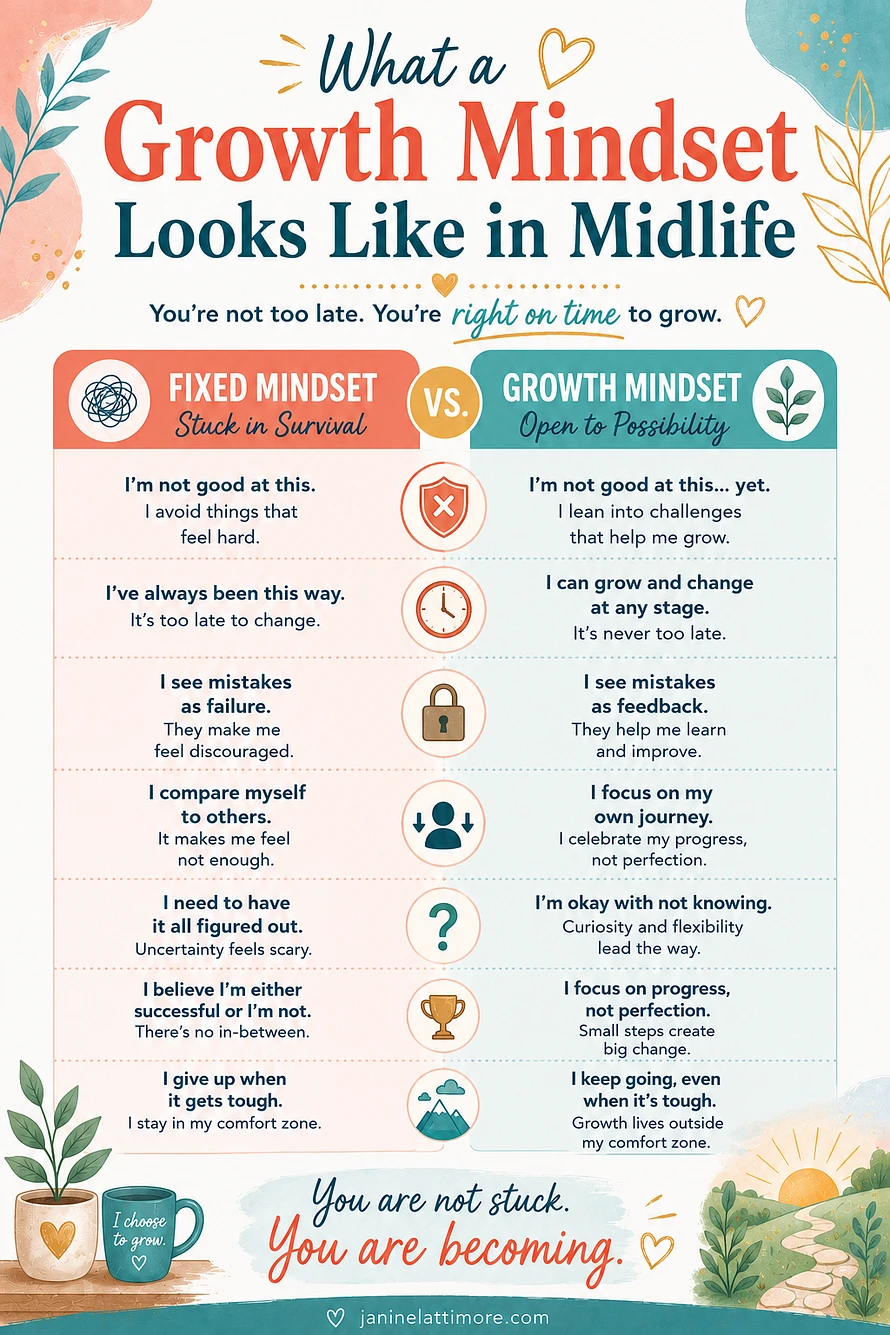
What a Growth Mindset Looks Like in Midlife
Instead of thinking:
❌ I'm too old to change careers.
Try:
✔ I can learn new skills at any age.
❌ My marriage ended so I'm a failure.
✔ My relationship taught me things I couldn't have learned any other way.
❌ I've wasted twenty years.
✔ Every experience has prepared me for what's next.
❌ I'm terrible with money.
✔ Financial confidence is a skill I can learn.
❌ I'm not confident.
✔ Confidence grows through action.
Create Safety. Unlock Growth. Transform Your Life
During my own experience of feeling like I was falling apart in my forties, I slowly realised that every setback contained information. Looking back now, I don't think I was failing. I think I was learning who I really was. When you approach living your life as experimentation, then your nervous system can relax. There is no failure, only information. Every outcome tells you something useful, and from that, your next step becomes clear. Instead of bracing for judgment or getting stuck in self-doubt, you stay in motion and feel curious, responsive, and grounded. The body feels safer when it knows: No matter what happens, I am safe and I know how to move forward. Success and failure stop being threats. They simply become signals guiding your next step. This is what makes a growth mindset particularly powerful. It regulates your nervous system as well as opening your mind which makes complete transformation possible.
Midlife isn't asking you to have all the answers. It's inviting you to become someone willing to keep learning, because personal growth doesn't end at forty, in many ways, that's where a new level begins.
Just One Thing
The “Just One Thing” action point for this post to help you make this real for your life is to notice what your thought patterns are when you make a mistake or get something wrong. Then, ask yourself: If this was an experiment, what information could I collect from this, and, based on that information, what is my next step going to be?
Aroha nui, much love
Janine