
Listen to the podcast version of this article here
Have there been times when someone you loved was going through a really difficult time, and you wanted to be there for them, but didn’t know what to say? When someone is hurting, struggling or facing a painful life change, it can be surprisingly difficult to know how to comfort them. You may worry about saying the wrong thing, giving unwanted advice or making their situation worse, so instead you say “I’m sorry” or “Let me know if you need anything” and hope it helps. However, comforting someone who is hurting isn’t about finding the perfect words or fixing their problem. Often, what they need most is simply to feel heard, understood and accepted as they move through something that cannot easily be fixed. In this article, we’ll look at how to support someone you love through a difficult time, including what to say, and what to avoid saying when someone is struggling, and how to be present without taking responsibility for making their pain go away.

This is particularly relevant in midlife, because there can be a lot going on in our lives, and in the lives of the people around us. Midlife can be tough. In many ways it is a similar time of hormonal and identity transition to the teenage years, but with a lot more responsibility and stress thrown in. People in their forties and fifties are commonly struggling with all sorts of big life issues such as:
The end of relationships and marriages
Dating in midlife and re-marrying
Loss of identity and former self
Loss of youth, physical capacity and fertility
Higher rates of chronic illness and terminal illness
Children leaving home or estranged children
Career endings, redundancy or career transitions or starting new businesses or projects
Loss of friendships and social circles
Unrealised dreams and roads not taken
Becoming a caregiver for aging parents
Parents with dementia
Death of parents and older relatives
In most of my articles and podcasts I focus on giving you resources for how to remain resilient yourself through all these types of experiences, but in this article, I want to give you tools for how you can effectively support your friends, siblings or partner when they are going through their own form of crisis in midlife.
Why is it So Hard to Comfort Someone Who is Hurting?
Many people really struggle to know how to comfort someone who is hurting or struggling. People either don’t know what to say or are afraid of saying the wrong thing. They worry about sounding fake if they just express a common platitude like “I’m sorry”, or fear misreading what the other person is experiencing or needing. Sometimes they don’t say anything because they don’t know the answer to the other person’s problem and think that in order to help they have to provide a solution. By midlife, we have had a bit of experience trying to support the people we love when they are going through a tough time and may have picked up a few skills, but most of us would benefit from having a better toolkit for what to say to someone who is going through a really hard situation.
Why We Struggle to Sit With Pain
The issue is not just that we don’t know how to comfort other people who are hurting or struggling. The underlying matter is that in Western society we are not taught how to sit with pain in general. We are taught to fix it if we can or otherwise suppress or avoid it in a multitude of ways. Pain is uncomfortable and we live in a society that craves comfort. Comfort is connected with strength, success and wealth, discomfort with weakness, failure and poverty.
What if we could develop a different perspective of pain that would empower us to respond to it in ourselves and others in a more beneficial way? Pain and discomfort are not just something experienced by people who are weak or poor. Everyone experiences them in some form at various times. Some people may have more resources to hide behind, but it will still be present there somewhere.
To be able to sit with other people’s pain we first have to be able to sit with our own. The first step in doing that is to understand that all emotions are simply a way of communicating information. I believe that all emotions are valid and serve us in some way. Therefore I think that it is more helpful to describe emotions as comfortable or uncomfortable, or pleasant or unpleasant, rather than judge them as good or bad, or positive or negative. Unpleasant emotions tell us that our needs are not being met, that we are unsafe or that we have patterns of thought and belief that are causing us to feel that something is wrong.
We become afraid of uncomfortable emotions. They can seem big and overwhelming and the way they are expressed can be hurtful, but that is because we have not all been taught how to process them effectively. People who have experienced trauma may also shut down to both their own and others' emotions which can be seen as a protective freeze response. Other people may respond to emotional stress with a fight response which looks like frustration or anger, or a flight response which looks like avoidance. When we understand that unpleasant emotions are simply signals asking us to pay attention to something, then managing them in ourselves and others becomes less scary. Less fear means less stress, and when we feel less stressed, we have more mental and nervous system capacity to respond.
(If you want to learn more about how to effectively feel and process your emotions then I go into that in more detail in Step 6 in my book 10 Steps to Happiness.)

Developing your own emotional intelligence and learning to process your own emotions in healthy ways is the first step in being able to comfort the people you love who are hurting or struggling. The next step is the skill aspect of what to do and what not to do.
What to Avoid When Someone is Hurting
A few of the things that I have included in the following list of what to avoid may surprise you because they are what many people commonly do when trying to comfort someone. They are not bad things, so if you have done them in the past please don’t judge yourself or worry that you have done the wrong thing. The things on this list are not wrong, I would just argue that they are not the most effective responses that you can give. This list is more to make you aware of the reasons these responses may not work so well, and then in the next section I will give you a list of things that do work well for you to focus on as helpful tools. What I am giving you here isn’t about rules or getting it “right.” These are things to be aware of, so you can decide what is most helpful in the situation in front of you.
1. Saying “I’m Sorry”
This one may come as a surprise because it is a very common response to say something like “I was sorry to hear that . . .” or “I’m sorry that happened to you” to someone who has experienced something undesirable or painful. The reason I advise you to avoid saying it, is because it puts a sense of responsibility and heaviness on you, and it really doesn’t offer anything to the other person. It is an empty statement and closes rather than opens conversation. It is an attempt to express sympathy, but there are more effective ways to do that
2. Trying to Fix the Problem
For example, saying something like, “You should try doing this...”
Offering unsolicited advice and trying to “fix” someone so that they feel better is one of the least helpful things you can do, because it overrides what they are thinking and feeling. Fixing, solving and rescuing someone indicates to them that they are not capable of working through this themselves. It links back to the perception that pain and discomfort are connected to weakness, failure and poverty, which isn’t true, and is not an empowering perspective to come from.
3. Sharing Your Own Experience
Many people try to show someone that they can relate to what they are saying by sharing their own similar experience. However, when you do this, it shifts the focus onto you. It also creates more information for the other person to process and this can add to their overload when they are already in a state of stress. This is especially impactful for people who are highly sensitive or have an ADHD or autistic neurotype. Simply listen, and reflect and ask questions about their experience first. Once the distressed person has processed their thoughts and emotions and are feeling more settled, if you have a personal story to share that may give them a helpful example then you could ask, “Is it okay if I share something that I think may be helpful?” If they say yes, then share, but ask first.
4. Trying to Cheer Them Up
Trying to get someone who is sad to smile or someone who is hurting to cheer up is again over-riding what they are actually thinking and feeling, and indicates that there is something wrong with what they are feeling. This often links back to people’s own discomfort with unpleasant emotions and trying to avoid dealing with them. The way to truly feeling better is through the feeling and processing of the uncomfortable emotion, and I’ll talk about how to do that in the next section.
5. Encouraging Them to “Look on the Bright Side”
This is another common thing people do which is linked to trying to cheer people up, but deserves to be looked at separately. It includes phrases like:
“At least you didn’t . . . “
“[They’re] in a better place now”
“It could have been worse . . .”
“[name] has it much harder than you”
“Everything happens for a reason.”
“Try and stay positive”
When you try and get someone to see the positive in their pain when they are in the midst of it, it minimizes and dismisses what they are currently experiencing. This goes double when you compare their experience and response to someone else. All of your feelings are valid for you regardless of what anyone else experiences, and feelings need to be felt to be effectively processed. The best way to comfort someone else is to acknowledge and validate their current experience and emotions and allow them to be expressed in ways that are safe.
6. Pointing Out Where They Went Wrong
Everyone makes mistakes or bad choices in life, and pointing them out doesn’t help. The person who is struggling is probably already painfully aware of any mistakes they made.
How to Comfort and Support Someone Who Is Hurting
Now that we have that awareness of the things that don’t work so well, let’s turn our attention to what does work effectively in terms of helping someone we love who is going through a difficult time. Most of these can be summed up with the concept that “less is more”. These tools are simple. You don’t need to learn a page of scripts to know what to say to someone who needs support. The key things are being present and accepting, and creating a safe space where the person feels seen and heard. That may sound complicated because it isn’t something that was modelled or taught to us growing up, but it actually isn’t hard. Here are seven simple tools that you can use to know what to say and how to support someone emotionally when they are going through a hard time.

1. Being Honest When You Don’t Know What to Say
You don’t need to have all the answers. You don’t need to know how to solve their problem to help someone. You don’t have to be a wise guru and say all the right things. If you don’t know what to say or do, just be honest and tell the person that.
You could say something like:
“I don’t know what to say, but I’m here for you”
or
“I am not sure how to respond other than to say I hear you and feel compassion for you”
Being vulnerable about what you are experiencing creates a safe space for them to express what they are experiencing, rather than having to put on a “brave face” or mask what is truly going on.
2. Listening Without Trying to Fix it
You may think that all you can do is listen, but often that is the key thing that the other person needs. Remember, what people need most is to be seen and heard. Listening while someone talks through their problem is validating and productive. Listen with all your senses, notice what they say, their body language, how they respond to things around them and non-verbal sounds like sighing. Ask questions related to what they are talking about. Also, be accepting of silence. Quiet pauses are okay. Sometimes people who are stressed need extra time to process their thoughts and emotions and put them into words. Give them plenty of thinking, feeling and speaking space, and the opportunity to simply sit in silence with you if that is what they need.
(If you want to learn some helpful conversation phrases that you can use to actively listen to someone then I give a list of these in my ebook guide, Stop Absorbing Other People’s Problems)
3. Creating a Safe, Calm Space
Be mindful of the environment you are in. If it is too loud, busy or lacks privacy then maybe suggest going for a walk or meeting up at another time for a quiet coffee or drink. Being in a calm place, particularly in nature, will help the person’s nervous system to settle, enabling them to be less driven by emotion and more able to think clearly.
4. Helping Them Name What They’re Feeling
Asking someone to name their feeling/s does two things: it clarifies for you what they are feeling, and it helps them to switch from the emotional to the logical language processing part of their brain. When you experience stress, your amygdala activates and takes over. You can think of this as your primal emotional brain. The pre-frontal cortex is the evolved part of your brain that allows you to think logically and rationally. When your amygdala is switched on, your pre-frontal cortex goes offline, and when your pre-frontal cortex is engaged, your amygdala quiets. Labelling your emotions with a precise word, engages the logical, rational part of your brain and quiets your primal emotional brain. Asking someone to name their emotions with a label of one or two words, can help to calm their emotions quickly without overriding or suppressing what they are feeling. To do this you could say something like: “Can you name the feeling you are experiencing?”
5. Validating Their Feelings
You can validate what the other person is feeling by reflecting back to them what you hear them saying or what you are observing, or by letting them know that it is okay or understandable to be thinking or feeling the way they are.
To do this you could say things like:
“It’s understandable that you feel . . .”
“It makes sense that you’re feeling . . .”
“It sounds like you are feeling . . .”
You can also identify things that they are doing that indicate they are struggling, for example saying something like:
“I can see that you are [e.g. having trouble walking] . . .”
“I can see by your tears that you feel really upset right now”
Validating someone’s feelings can also include affirming that what they are experiencing is hard, painful or frustrating. Acknowledging that what they are experiencing is awful creates a space where they can relax and not have to act like everything is okay when it is not. A lot of bad things can’t be fixed, and sometimes the most comforting thing you can do is simply sitting with someone and being honest about how horrible their situation is. Not in a “pity-party” kind of way, but in a way that allows for the relief of being able to tell it like it is.
For example saying “That [e.g. sucks/stinks/sounds awful]”
6. Asking What They Need
People process things in different ways and at different times so even if you know someone well, it is always a good idea to ask them what they need in that moment rather than assuming what would be good for them. It is best to be specific rather than saying something general like “let me know if you need anything.” Some people find it challenging to ask for assistance, so it can be helpful to make your request into just one step and ask, “what is one thing you would like me to do for you right now?” This can also be helpful if the person is feeling very overwhelmed and having trouble planning. Remember that when we are in distress (stress) our emotional brain takes over and we can find it hard to access our rational, logical pre-frontal cortex. If someone is really struggling to think rationally, they may not be able to process what they need. In this case you could offer specific, tangible actions which may be helpful to them.
It is also beneficial to ask for what they need at the moment or right now because it requires less thinking to identify what we need currently as opposed to thinking longer term. It also guides the other person to focus on the present moment rather than spiralling into the past or future which they have no control over.
You can use questions like:
“What can I do to support you right now?”
“What do you need at the moment?”
7. Letting Them Know You’re There for Them
Even people who like to have personal space to process, desire forms of support. You can reassure someone that you are here for them with phrases like:
“I’m here to support you as you move through this”
“How about we make a time to go for a walk and catch up?”
“Being here for you is the most important thing to me right now”
It is also advisable to balance caring for others with caring for yourself. Even if the other person is emotionally fragile, it is okay for you to create boundaries for your own self-care, because in order to be able to effectively support others you need to be resourced yourself.
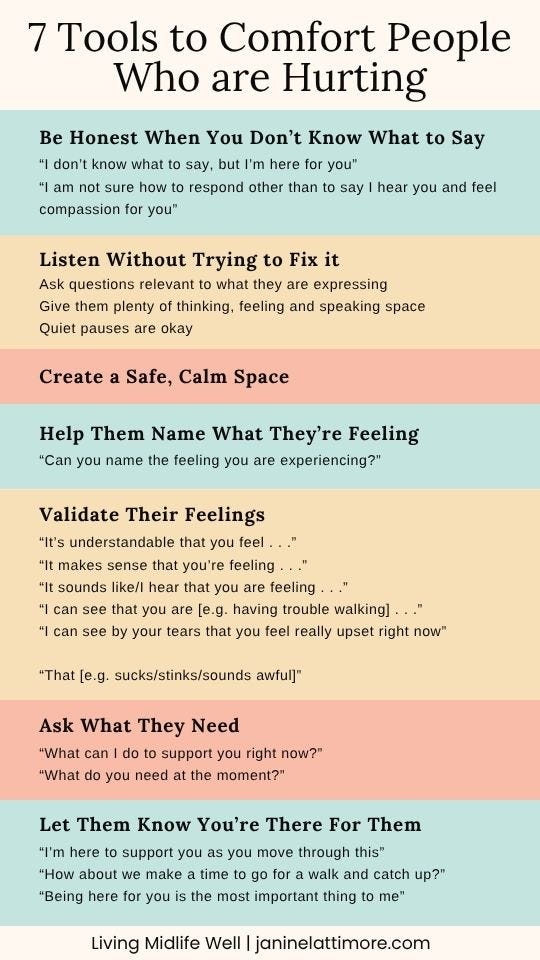
Click here to access a free download phone wallpaper summary of these 7 tools
You Don't Have to Fix Someone's Pain to Help Them
When someone you love is hurting, you don’t need to have the right answer, find the perfect words or make their pain disappear. What you can do is be there. Listen without rushing to fix, acknowledge what they are feeling without judging it, ask what they need and give them the space to move through their experience in their own way. Comfort isn’t about making someone feel better as quickly as possible. It is about helping them feel safe enough to be exactly where they are, and perhaps the greatest gift you can give someone who is struggling is the reassurance that they don’t have to pretend everything is okay when it isn’t. Sometimes, presence is more powerful than advice, and simply knowing that someone is willing to sit beside you while life is hard can make all the difference.
Just One Thing
This week’s “Just One Thing” action point is to practice noticing, naming and accepting your own feelings as valid for you whatever they may be. The more you learn to hold space for your own emotions in this way, the better you will be able to do it for other people as well.
Over the next few days, when you notice that you are experiencing an emotion try naming and accepting your feelings by using simple statements like the ones below.
“I feel . . .[sad, frustrated, angry, afraid, excited, peaceful, upset, devastated, confident, tired, overwhelmed, shut-down, full, blocked, delighted . . .]”
and then,
“It’s okay that I feel . . .”
Notice what you’re feeling.
Name it.
Then, rather than immediately trying to change it, fix it or push it away, simply remind yourself:
It’s okay that I feel this.
The more comfortable we become with our own emotions, the more capable we become of sitting alongside someone else when they’re experiencing theirs.
Listen to the guided meditation version of this practice here
Let’s have a conversation about this. Do you have any wisdom to share about how to respond to people who are hurting? Is there anything you would add to these lists of what to avoid or to do?
Do you know someone who could really do with knowing this information? Feel free to share this post with them.
If you found this interesting or helpful then you can Subscribe to my newsletter for more great tips on how to slow down, feel better and enjoy midlife more—one simple step at a time
Aroha nui, much love
Janine
Frequently Asked Questions: How to Comfort and Support Someone Who Is Hurting
How do you comfort someone who is hurting?
The most helpful way to comfort someone who is hurting is often to be present, listen without trying to fix the problem, acknowledge what they are feeling and let them know you are there for them. You don't need to have the right answer or make their pain disappear. Creating a safe space where they feel heard, understood and accepted can be more comforting than offering advice or solutions.
What do you say to someone who is going through a difficult time?
You don't need to find the perfect words. If you're unsure what to say, you can be honest: “I don't know what to say, but I'm here for you.” You can also reflect what you hear them saying, acknowledge that their situation is difficult, or ask, “What can I do to support you right now?” Simple, genuine responses are often more helpful than trying to come up with something profound.
What should you avoid saying to someone who is hurting?
There are several common responses that may not be particularly helpful when someone is struggling. These include immediately trying to fix the problem, comparing their situation with someone else's, encouraging them to “look on the bright side”, trying to cheer them up, or pointing out where they went wrong. These aren't necessarily wrong things to say in every situation, but they can unintentionally minimise what the person is experiencing or shift attention away from their feelings.
How do you support someone emotionally without trying to fix them?
Start by listening and allowing the person to express what they are thinking and feeling without immediately offering advice. You can reflect what you hear, validate their feelings, ask what they need right now and offer practical support if appropriate. Supporting someone doesn't require you to solve their problem. Sometimes the most helpful thing you can offer is your presence and acceptance.
How do you comfort someone when you don't know what to say?
You can simply acknowledge that you don't know what to say. Saying something like “I don't know what to say, but I'm here for you” or “I hear you and feel compassion for you” can be more supportive than trying to manufacture the perfect response. Being honest about your uncertainty can also create a safe space for the other person to be honest about what they're experiencing.
How can you help someone who is struggling?
One useful starting point is to ask them what they need rather than assuming you know. Instead of saying, “Let me know if you need anything,” ask something specific such as “What can I do to support you right now?” or “What do you need at the moment?” If they're overwhelmed and struggling to think, you can also offer a specific, practical form of help.
How do you validate someone's feelings?
You can validate someone's feelings by acknowledging what you hear or observe without judging or trying to change it. Phrases such as “It's understandable that you feel...”, “It makes sense that you're feeling...”, or “It sounds like you're feeling...” communicate that their emotional response is being heard and accepted. You can also acknowledge that their situation is genuinely difficult rather than trying to find a positive side to it.
Is listening enough when someone is hurting?
Sometimes, yes. Listening can be one of the most valuable things you can do for someone who is struggling. Giving someone space to talk, think, feel and even sit in silence can help them feel seen and heard. You don't necessarily need to provide advice or a solution for your support to be meaningful.
How can I be there for someone without taking on their problems?
Being there for someone doesn't mean taking responsibility for making their situation better. You can listen, offer support, ask what they need and reassure them that you're available while still maintaining appropriate boundaries around your own wellbeing. In fact, looking after your own resources is important because you need to be resourced yourself in order to support someone else effectively.
If this is something you tend to do and want some more help with protecting your own boundaries or energy then I give more detailed information about this in my guide: Stop Absorbing Other People's Problems
What if the person doesn't want to talk?
If someone doesn't want to talk, you don't need to force a conversation. Give them the space they need while letting them know that you are there for them when they're ready. Sometimes simply sitting quietly with someone can be supportive, particularly when they are stressed and need time to process their thoughts and emotions. You can offer your presence without demanding that they explain how they feel, and reassure them that you're available when they do want to talk. Supporting someone doesn't always mean having a conversation. Support isn't the same as getting someone to talk. It can simply mean being willing to sit or walk beside them while they move through a difficult time.
What is the most important thing to remember when comforting someone who is hurting?
You don't have to fix someone's pain to help them. Being present, listening without judgement, acknowledging their experience and allowing them to be where they are can be profoundly supportive. Sometimes simply knowing that someone is willing to sit beside you while life is difficult can make all the difference.

Photo of two people by Kylli Kittus on Unsplash